Lot details
Detailed description
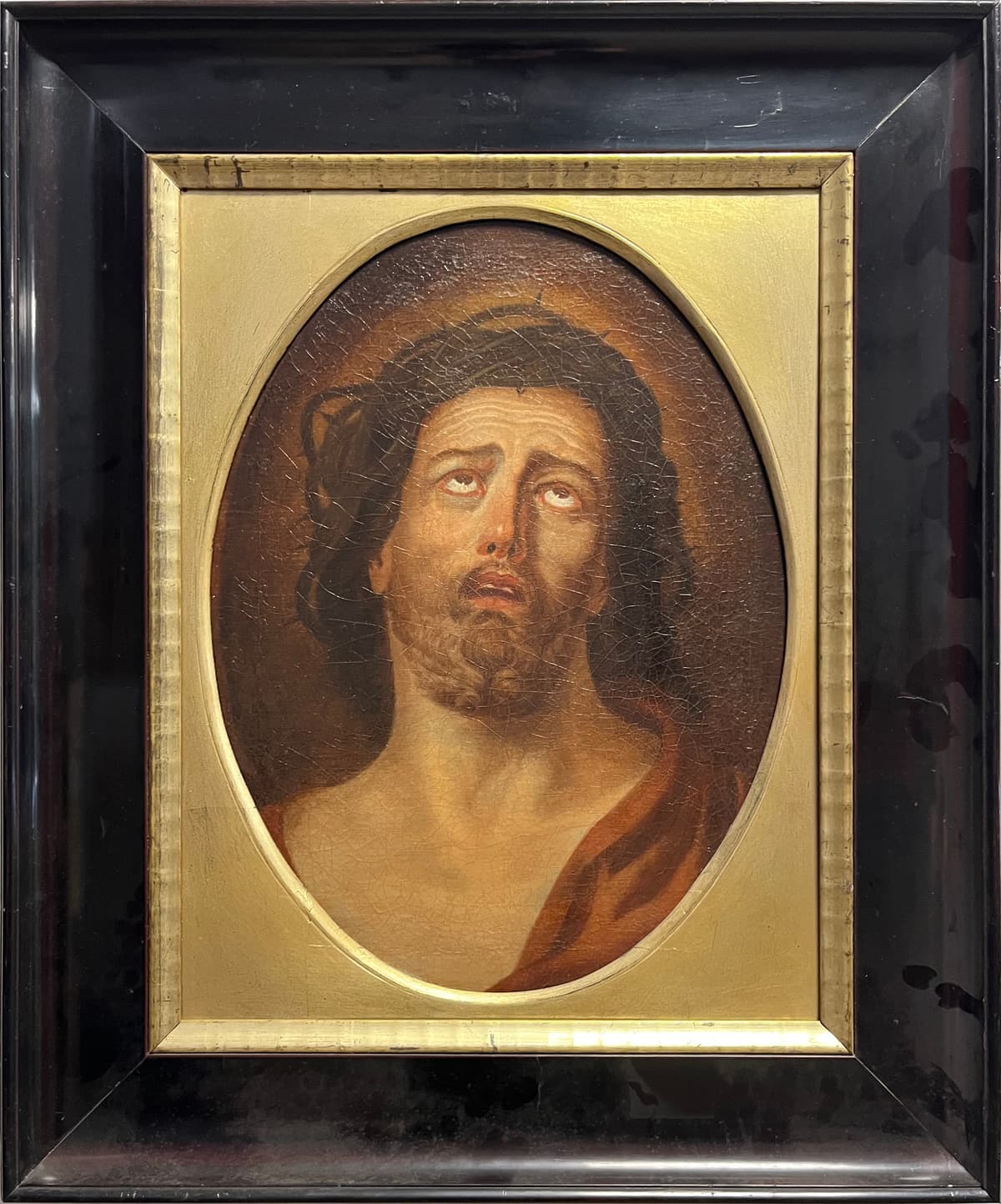
Oval field, half-length portrait of Christ: the head tilts slightly backward, the gaze is directed towards the sky; the mouth is slightly open, and the expression conveys the pious pain of the passion. The composition is tightly cropped, the background is homogeneous, deep brown; the light highlights the forehead–cheekbone–nose bridge zone, plastically modeling the form. The color palette is built on warm ochre–terra and broken flesh tones, with reddish drapery running across the shoulder. The brushwork is smoothed, medium-fine; the surface's small, net-like craquelure indicates natural aging. The inner gold mat reinforces the oval emphasis, while the black outer frame provides a dramatic contrast. Iconographically, the Ecce Homo / Suffering Christ type is a more intimate, meditative version (the crown of thorns does not appear here; the upward gaze and the red cloak refer to the scene). Style direction: late baroque–academic devotional art; probable decade: 1760–1790 (alternatively historicizing, 1800–1830).
Author is unknown.
Guido Reni circle (active: around 1590–1642, followers 17th–18th centuries) – an upward-looking, lyrical Ecce Homo-type model; iconographic-compositional legacy. The Fitzwilliam Museum+1
Carlo Dolci school (Dolci active: 1630–1687) – smoothed, "enamel-like" surface, intimate devotion, tradition of small devotional images. christies.com
Ribera-influenced, Spanish–Neapolitan followers (Ribera: 1610–1652; followers 17th–18th centuries) – dark background, strong chiaroscuro, expressive head type.
Central European academic workshop (Vienna/Prague, 1760–1820) – oval "head types", softened baroque modeling, church/home devotional use.
Italian late baroque-salon painter (1750–1820) – balanced light, warm palette, smooth surface.
19th-century historicizing master (1800–1830) – gentle reconstruction of baroque prototypes, framing emphasizing oval shape.