Lot details
Curators

Ács Érmes Károly
curator
ermesprojekt@gmail.com

Ohnhaus Éva
curator
eva.artdeco@gmail.com
Detailed description
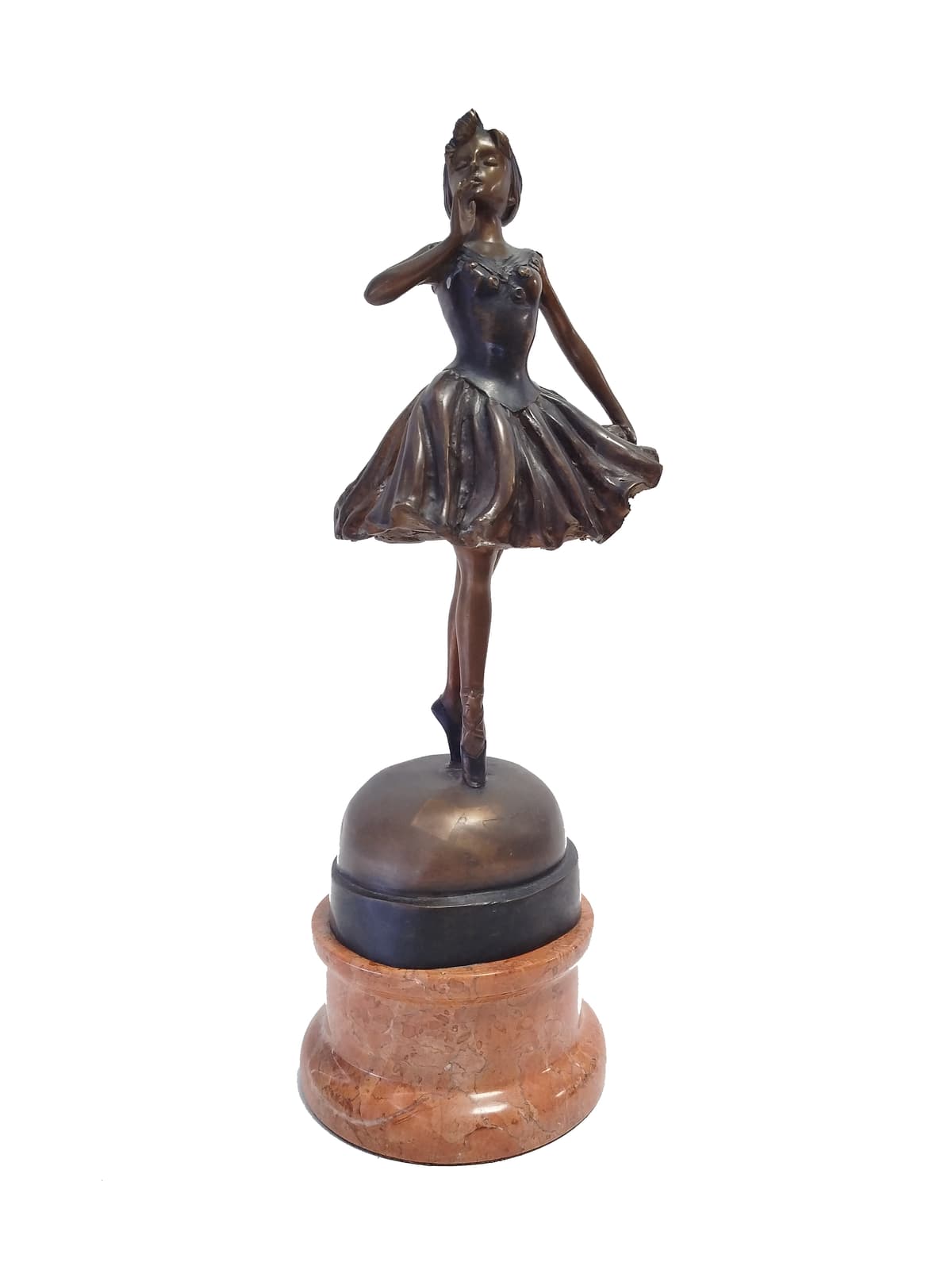
kiss for the audience Art Deco
The delicately patinated bronze small sculpture standing on a red marble base depicts a young ballerina, who appears in a graceful pose with effortless elegance. The statue evokes the world of iconic Degas ballerinas, but it was likely made in the second half of the 20th century as a decorative bronze casting, which has more value as a collector's item or interior decoration than in a museum context. The virtue of the composition is the detailed elaboration of the skirt, the softly modeled facial features, and the timeless depiction of classical dance art. The marble base enhances the statue's solemnity, while the smooth, dark patina emphasizes the nobility of the movement. In the Hungarian auction market, there is a continuous interest in such 40–50 cm bronze small sculptures, primarily as home decor accessories or gifts.
Author Candidates
No named creator; the piece was likely made in the decorative foundry bronze style following Degas. Possible authorship circle (stylistic relatives, thematic parallels):
Demétre Chiparus (active: 1914–1940) – Relevant parallel due to Art Deco dancers, flowing drapery, and elegant poses.
Claire Jeanne Roberte Colinet (active: 1900–1940) – Delicately formed dancer figures with feminine gestures; decorative attitude.
Pierre Le Faguays (active: 1914–1960) – Dynamic dance figures, stylized, slender body proportions.
Josef Lorenzl (active: 1910–1935) – Elongated, graceful female figures; decorative stage themes.
Bruno Zach (active: 1918–1935) – Stage female figures, dynamic drapery; commercial bronzes.
Marcel-André Bouraine (active: 1920–1945) – Dance themes, simplified surfaces, and strong silhouettes.
Richard MacDonald (active: 1990–) – Ballet iconography; although later, the thematic choice is related.
Contemporary Italian/Spanish foundries, anonymous modellers (1960–1990) – Ballerina bronzes made for the gift market, with marble bases.
If a mark, foundry mark, or signature emerges, the circle can be specified.