Lot details
Curators

Ács Érmes Károly
curator
ermesprojekt@gmail.com

Ohnhaus Éva
curator
eva.artdeco@gmail.com
Detailed description
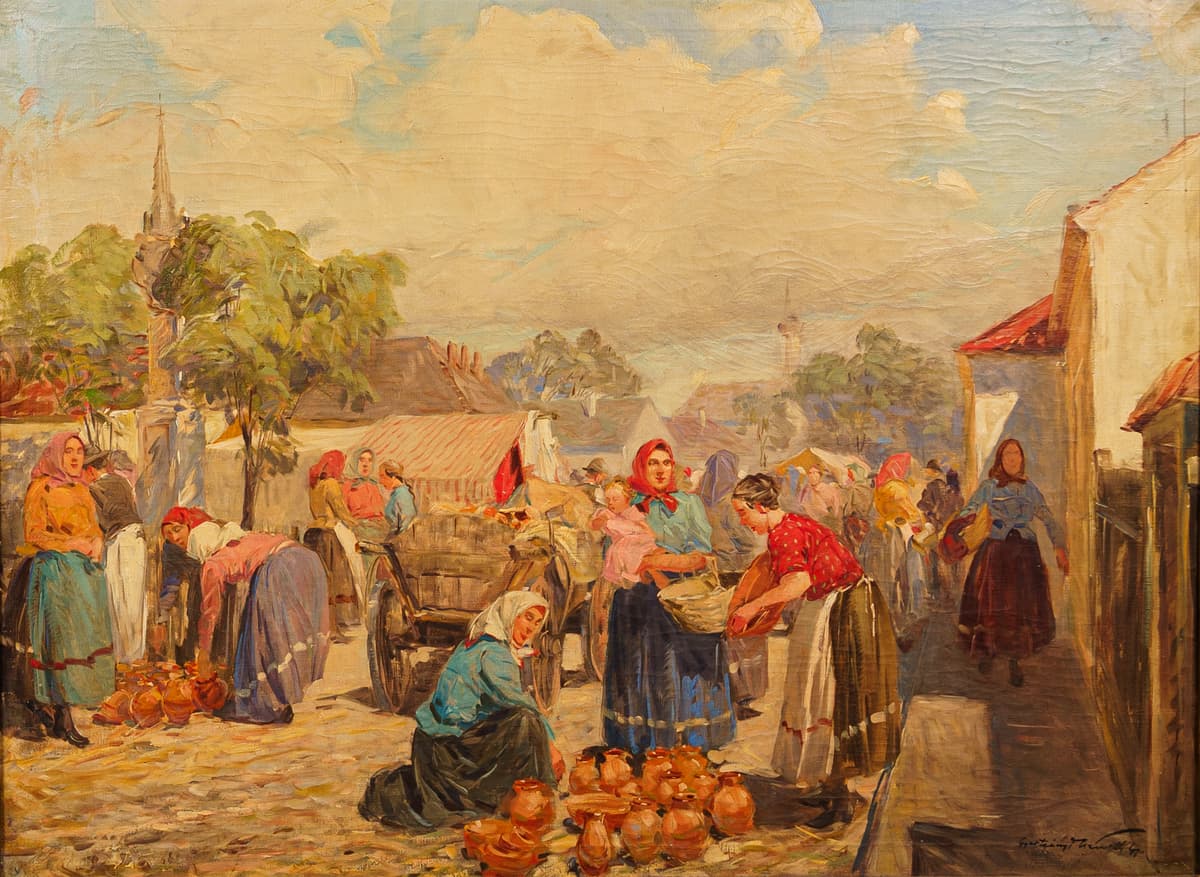
A crowded village market square unfolds in the center of the canvas, viewed from a slightly elevated perspective. To the right, the row of houses and the diagonal of the narrow street guide the gaze into the distance, while on the left, trees and a column-like sculpture divide the space. In the foreground, a group of terracotta jugs and female figures in red shawls and blue skirts; one holds a child, while another is weighing goods. In the middle ground, a wooden cart, behind which are stands covered with tarpaulin, and in the background, the silhouette of a church tower can be seen. The color palette is built on warm earth tones (yellow ochre, burnt sienna) and fresh blues, with vibrant red accents. It is characterized by loose, energetic, occasionally impasto brushwork and quick, fragmented texture; the sunlight is strong, casting contrasting shadows in the early afternoon. The traditional garments, shawls, and the iconography of the wooden cart evoke rural life in Hungary between the two world wars. Overall, it is an outdoor-inspired, naturalistic-impressionist genre; likely created in the 1930s–1940s.
Key details:
A woman crouching in the front left with terracotta vessels
A wooden cart and tarpaulin sheds in the center
A mother with a child in a red shawl
A shadowy alley on the right with strong light-shadow contrast
A slender tower and leafy trees in the left background
Named creator: Gyertyáni Németh Gyula (1892–1946). A Hungarian painter, active from the late 1910s to the 1940s. The main themes of his art are scenes of peasant life, market and village genres, as well as landscapes. His painting style is plein air, light, with powerful local colors and vibrant figurative composition. His signature typically appears in the form of "Gyertyáni Németh Gy." in the lower right corner – clearly readable on this work as well.