Lot details
Curators

Ács Érmes Károly
curator
ermesprojekt@gmail.com

Ohnhaus Éva
curator
eva.artdeco@gmail.com
Detailed description
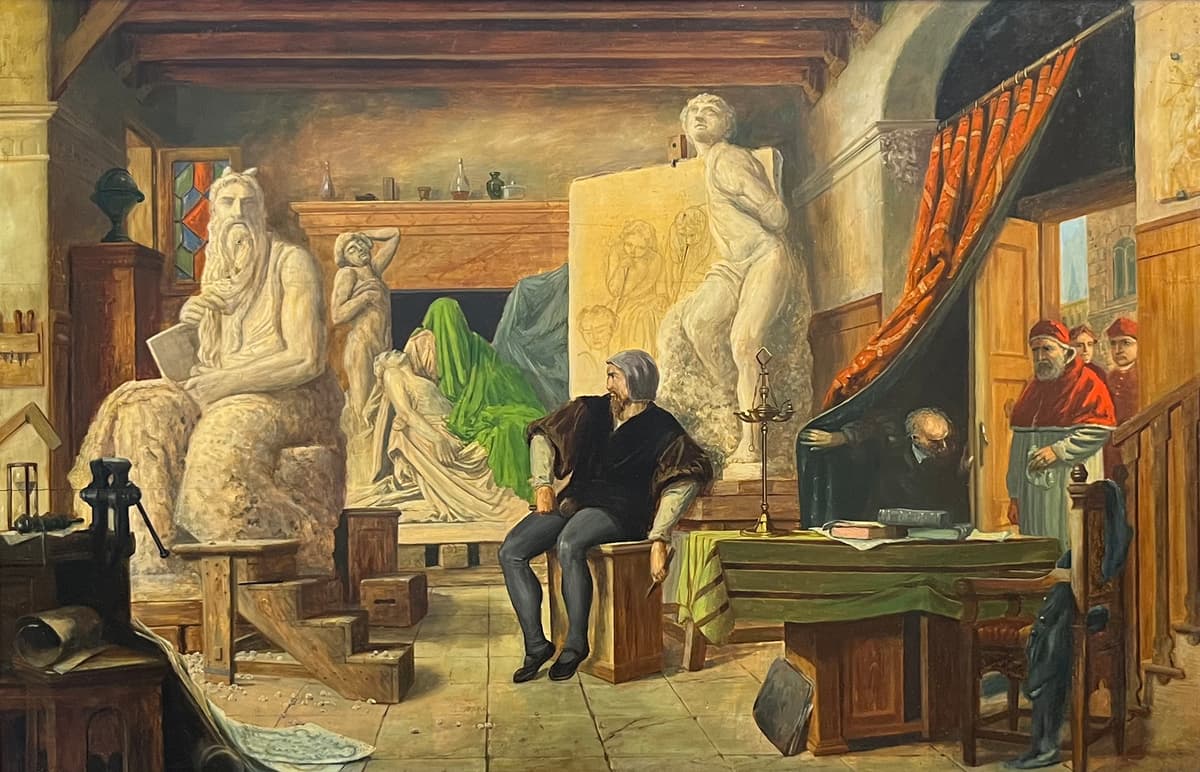
The scene leads into a Renaissance sculptor's workshop: calm, warm-toned light spreads over the beamed ceiling and stone floor. In the center sits a bearded man in a black jacket and gray cap, holding a chisel in his lap – the composition identifies him as the Renaissance master. To the left sits a monumental, roughly carved marble figure (Moses motif), behind it a draped group (Pietà), with smaller plaster and marble fragments in the background. To the right, in front of a partially carved figure (Slave), a stone tablet filled with sketches stands. At the entrance, a servant pulls aside an orange-red brocade curtain; behind him, a high priest in a purple robe and his attendants enter. The painter works with delicate, smooth brushwork, precise perspective, and a detailed material world; the vibrant contrasts of the green and red draperies animate the image, while conveying the marble surfaces with chalky, cold reflections. Iconographically, it is an allegorical evocation of Michelangelo’s workshop. Style: 19th-century academic-historical painting; likely decades: 1850-1860s.
Key details:
A seated figure resembling the Moses statue on the left, with rough working.
Pietà group covered with a green cloth in the background.
A partially unwrapped “Slave”-type figure on the right.
Drawn figures on the stone tablet – workshop sketches.
High priest and entourage arriving from behind a red brocade curtain.
Potential authorship candidates
The designation is: "Circle of Henrik Weber (1818-1866)". The following painters are potential candidates stylistically and educationally:
Henrik Weber (active: 1840s-1860s) – Hungarian academic historical painter, precise drawing discipline and theatrical composition; the choice of theme and setting aligns with his workshop.
Orlai Petrics Soma (active: 1840s-1870s) – his historical scenes have an intimate, stage-like spatial structure and detailed props.
Jakobey Károly (active: 1850s-1880s) – a detailed, clean drawing academic style, often composing in interior spaces.
Influence of Rahl Ferenc/Friedrich von Amerling (active: 1830s-1860s) – Vienna academic training, silky surfaces, and classicizing figures.
The circle of Carl von Piloty (active: 1850s-1880s) – Munich school, dramatic historical scenes, rich props, and stage lighting.
Early circle of Székely Bertalan (active: 1850s-1890s) – disciplined drawing, historical themes; his early works are akin to material detail.
Madarász Viktor (active: 1850s-1870s) – romantic historicism, while generally having darker tones, still shows compositional affinity.
The circle of Kaulbach Vilmos (active: 1840s-1870s) – great narrative ability, sensitivity to Renaissance themes.