Lot details
Curators

Ács Érmes Károly
curator
ermesprojekt@gmail.com

Ohnhaus Éva
curator
eva.artdeco@gmail.com
Detailed description
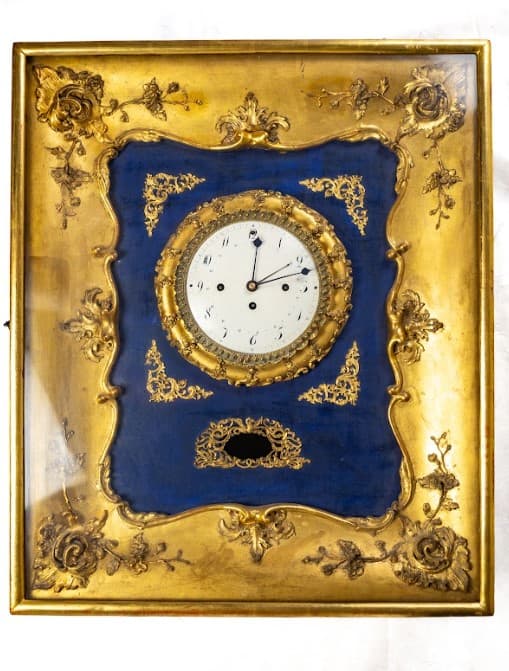
Square wall clock of "rahmenuhr" type, with a gilt frame and a deep cobalt blue background. In the center, there is a round, white enamel dial featuring fine, calligraphic Arabic numerals and blue-steeled hands; the inner scale, marked from 29 to 31, refers to a simple calendar hand. The dial is surrounded by a richly decorated gold-plated bronze/pressed copper frame, inspired by Rococo, with a bead and floral motif. The blue field is segmented by several gold rocaille applications; at the bottom, an oval, cartouche-shaped opening provides a view of the swinging pendulum's motion. Under the protective glass surface, the blue background is presumably painted or covered with velvet. At the corners of the frame and along the undulating contour, decorative vine motifs and rosettes can be seen; the play of light and shadow is created by the high relief gilding and the strong contrast of the dark blue background. The composition, the calligraphic numerals, and the lush bronze castings evoke the taste of the Rococo revival/Napoleon III period. Likely dating: 1850–1870s, from a German (or Viennese-influenced) workshop.
Key details:
White enamel dial with Arabic numerals and calendar scale
Blue background with gold rocaille applications
Richly decorated, gilt bronze/pressed copper dial frame
Bottom, cartouche-shaped pendulum window
65 × 54 cm wall-mounted "Rahmenuhr" type
Author attributions
No named creator; the object is more likely a product of a German clockmaker workshop. Possible manufacturers/workshops:
Lenzkirch Clock Factory (1851–1929) – known for quality wall clocks, intricate castings, and fine enamel dials.
Gustav Becker, Silesia (1847–1935) – a wide variety, including ornate wall clocks in French taste.
Winterhalder & Hofmeier (1810–1930) – high-end German wall clocks, often featuring Rococo-inspired cases.
Lorenz Furtwängler Söhne, Black Forest (1836–1929) – good quality movements and decorative cases.
Philipp Haas & Söhne (1867–1920) – decorated Black Forest cases, enamel dials.
Johann Baptist Beha workshop (1815–1898) – though mainly known for carved clocks, but features meticulous Black Forest craftsmanship.
Viennese (Austrian) "Rahmenuhr" workshops, 1820–1870 – formal parallels due to the blue background and bronze castings.
To clarify the attribution, markings on the back/structure are necessary.