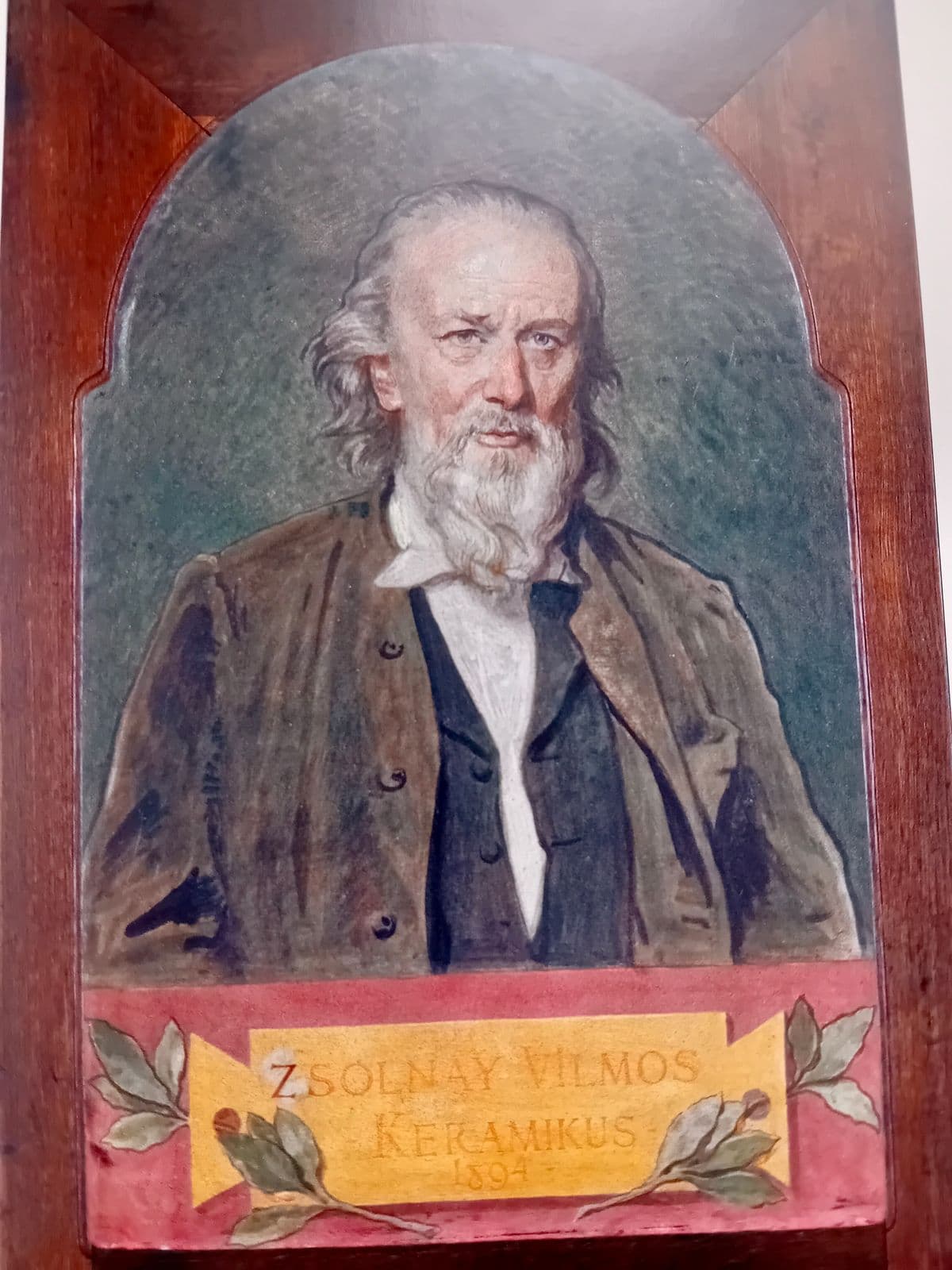
Dive into the century-and-a-half secrets of the Zsolnay dynasty, where folk motifs, Eastern influences, and family legends converge. Discover how the masterpieces that made the Pécs manufactory world-famous came to be. Join us in the pursuit of Zsolnay mysteries and take a peek into the exciting world of shapes, patterns, and signatures!
To unlock the secrets, we must start our investigation a century and a half ago to glimpse the secrets that have made the name of Vilmos Zsolnay and his family memorable and even world-famous, alongside their unparalleled work.
From the start of his work in 1853, with the establishment of a ceramic manufactory, the founder Zsolnay Vilmos meticulously and consciously laid the foundations for his global success. First, he conquered the market with a series of products serving early architectural development, then, with the involvement of family members TERÉZ - JÚLIA – MIKLÓS in designing and producing, he established the success of the decorative goods production.
The porcelain faience and architectural ceramics manufactory’s development began with a logically ordered expanding range of products.
With fundamental logic, production continuously operated under the principle of SERVING HUMANITY... When we hold in hand a series of pink glazed pitchers from the simply shaped early period, we immediately feel that the production taking place in Pécs was not of trivial items.
Which household wouldn’t gladly accept these functional objects, which in daily use served as water jugs, milk containers, or perhaps jam pots, appearing in various sizes on the tables?
Of course, after the monochrome glazed objects, it was just a leap to the creation of intricately painted items...
According to tradition, family members went on weekend excursions to the villages surrounding Pécs, from where the richness of forms and the origin of some patterns were sourced, as well as inspirations from the collected ceramics for the sample designs.
Let us not forget the historical legacy of what they saw and gathered, as remnants of distant Turkish ceramics, their forms and patterns emerged during the collection. The source of the secrets, naturally, is rich due to the diverse environment; it is a historical fact that the populations of Tolna – Baranya counties were very multi-ethnic. Germans, Sokac, Bunjevci, Serbs... and who knows which other nations lived their lives in the vicinity.
All this is an element of the secrets, as the multi-ethnic landscape, like a treasure trove, preserved its material culture and the ethnically preferred “decor” patterns according to their taste.
Well, this source also leads us to distant continents, as the traditions of Turkish IZNIK ceramics and the forms of the Persians both transitioned into the decorative goods of ZSOLNAY during their design. The treasures of Eastern craftsmanship, with richly patterned stylized floral motifs, still amaze us today when we take in hand beautifully shaped pots, vases, and serving dishes. All it takes is to glance at the attached Iznik ceramic underplate decorated with clove-tulip flowers, or the form of the second jug - "Victorious Prince" - from the treasure of Nagyszentmiklós discovered during the conquest, featuring griffin bird embellishments...
However, we also have another source for identifying the unmistakable ZSOLNAY items. Namely, the signature painted in blue under the glaze, intertwining the creators and the production site, which serves as clear evidence; yes, this item is a ZSOLNAY product from the second half of the 19th century...
The secrets reveal themselves here too, as the former German name of PÉCS
"FÜNFKIRCHEN" - Five Churches - symbolically corresponds with the initials of the creators' names "T - J - M" meaning ZSOLNAY TERÉZ, ZSOLNAY JÚLIA, and ZSOLNAY MIKLÓS ... the three children of the factory’s founder. Of course, the secrets also reveal further information to the divers of the past about the objects. Specifically, the various numbering precisely delineates when our particular item may have been manufactured. The factory’s two meticulously maintained special books provide the answer to this question. One book preserved the forms, while the other series preserved the patterns as invaluable values of the past. Therefore, the FAZON and DEKOR books opened in 1873, which are maintained until 1984 and 1970 respectively, give very accurate information about when the Zsolnay masterpiece we hold in our hands could have been created based on its markings.
The FAZON BOOKS number 18, while the DEKOR BOOKS preserve the imprints of the creators’ work in volume 9 regarding the ZSOLNAY secrets...
With the help of these invaluable legacies, we were also able to precisely determine the age of the wonderful Zsolnay items at the Földváry Auction on December 12, 2025.
For my readers, after getting to know the revealing secrets, there remains nothing but to carefully preserve the objects of the historical legacy of the past 150 years according to their taste.
According to the family intentions of ZSOLNAY MIKLÓS, the goal is to preserve the magnificent artistic and utility value of his legacy for today's generation, even by acquiring ZSOLNAY items by bidding at the upcoming auction.
Károly Érmes Ács
chief curator