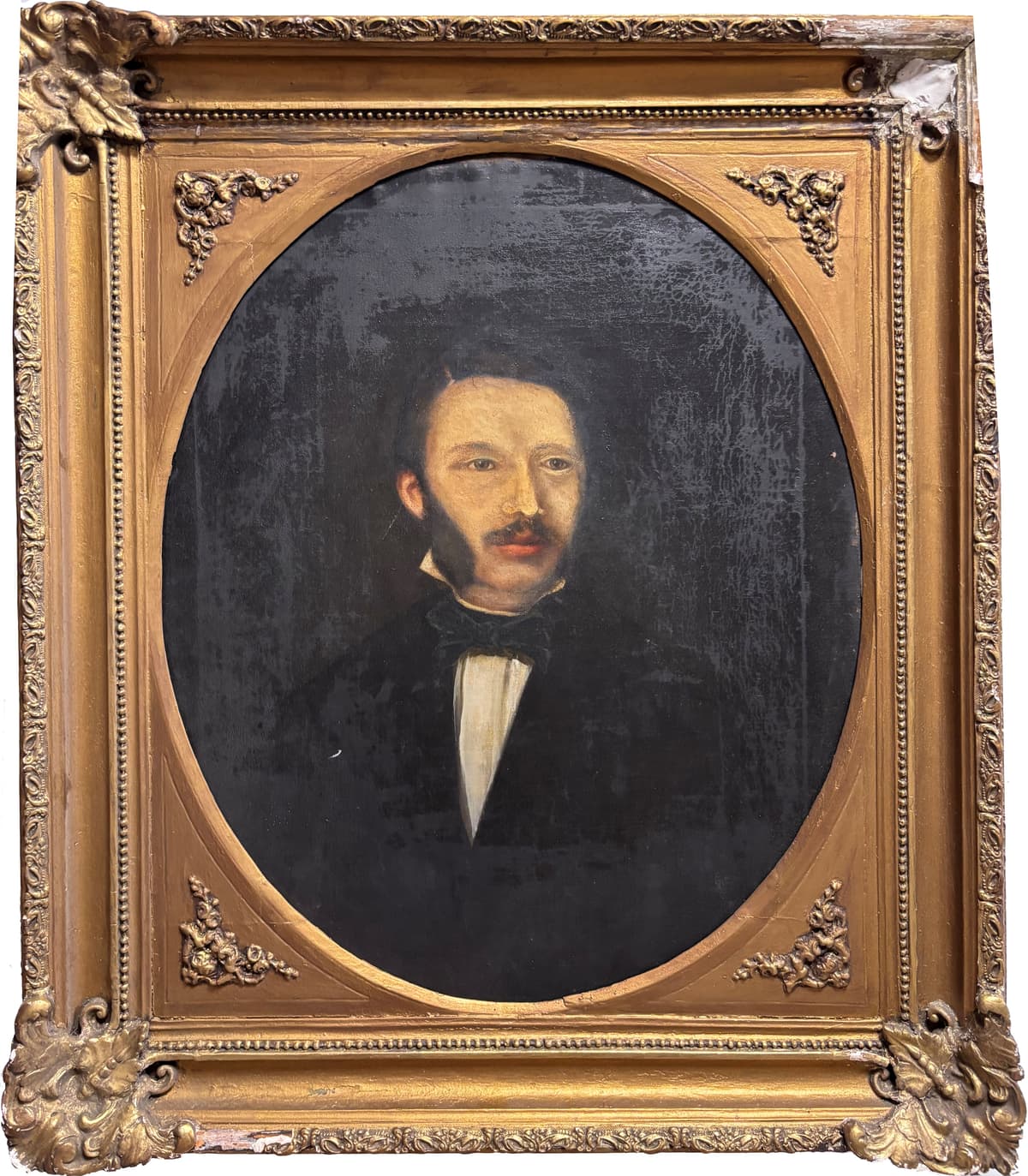
Barabás Miklós utánzat, ismeretlen festő
Vörösmarty-portré
Description
No description available yet.
Detailed description
The composition of the portrait, its facial type and clothing are indeed surprisingly close to several well-known depictions of Mihály Vörösmarty (1800–1855) – especially to the traits made famous by Miklós Barabás’s lithographs and oil portraits presented to the Hungarian public in the 1840s.
Let’s take a detailed look at the arguments for and against it:
Arguments in favor of identification
Facial characteristics and hairstyle:
The man depicted in the painting has a strong, slightly protruding forehead, a “clean-featured” face, and distinctive sideburns and mustache – which exactly matches the form shown in Miklós Barabás’s 1841 portrait of Vörösmarty.
The style of hair and facial hair can be dated to the 1840s–1850s, when Vörösmarty was already a nationally recognized poet.
Attire:
The black frock coat, white vest, starched collar, and black tie are classically representative of the attire of the educated classes in Pest during the 1840s.
This matches the portrait attire preserved from Vörösmarty by the Pest Artistic Society–Miklós Barabás.
Style and era:
The style of the painting (realistic tones, dark background, oval composition) completely conforms to the conventions of Hungarian portrait painting between 1845 and 1855.
This coincides exactly with the last active decade of Vörösmarty's life.
Expression and pose:
The gaze is directed slightly upward and to the right, suggesting mental concentration and intellectual posture – this was also a typical motif in Vörösmarty’s portrayals during the reform period.
Considerations against identification
Lack of documented signature or dedication:
No signature, name, or inscription is found on the image to confirm the identification.
Known portraits of Vörösmarty (Barabás, Brocky, Stettner) usually feature some inscription or have a known original commissioning background.
Lack of other portrait versions:
Known representations of Vörösmarty are mostly frontal or slightly turned to the right; the body posture facing the viewer and the slightly turned head to the left in this painting is a rarer arrangement.
Possible minor regional workshop work:
Based on the brushwork, it is likely that a secondary rural portrait painter copied Vörösmarty's image from a contemporary engraving – it cannot be ruled out that it is not an original but a copy or homage portrait.
Probable conclusion
The painting is likely a 19th-century portrait of Vörösmarty, or a copy modeled after Vörösmarty (possibly commissioned as a tribute piece).
Based on its style and composition, it suggests inspiration from Miklós Barabás or his circle (e.g., Károly Brocky, Béla Stettner) but does not bear their signature.
If the Vörösmarty identification can be confirmed (e.g., based on period sources, ownership provenance):
CategoryValue (HUF)Undocumented Biedermeier portrait200,000 – 320,000 HUFPainting identified as Mihály Vörösmarty (with confirmed source)800,000 – 1,200,000 HUFAttributed Barabás workshop piece1.2 – 1.8 million HUF