Cailluamé
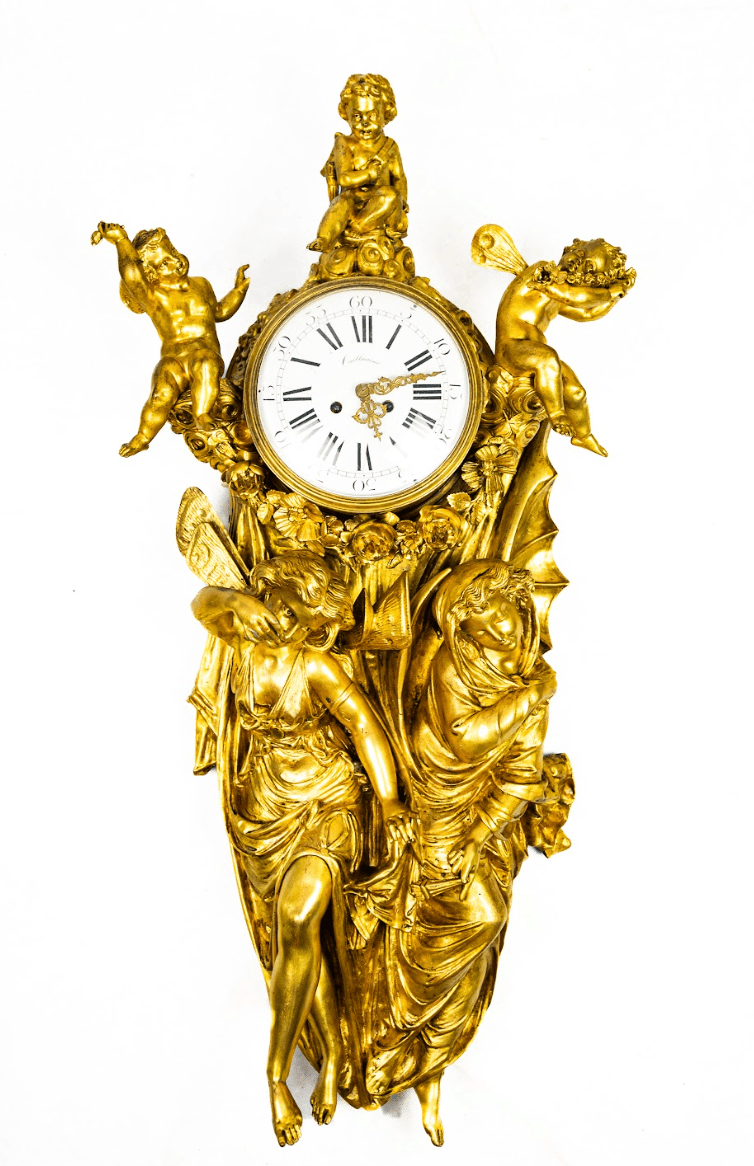
Cartel wall clock with fire-gilded 'Day and Night' puttos, very rare piece
Description
No description available yet.
Curators

Ohnhaus Éva
curator
eva.artdeco@gmail.com
Detailed description
The mythology of day and night plays a central role in many cultures and mythologies around the world, often depicted as a pair of opposites whose interaction and cyclical alternation symbolize the order of the world and the rhythm of life.
Greek mythology:
Nyx (Night): In Greek mythology, she is the goddess of Night, born from chaos, and the mother of several other deities, including Death (Thanatos), Dream (Hypnos), and the goddesses of Fate (Moirai).
Erebus (Darkness): Nyx's husband and brother, the god of darkness.
Helios (Sun): The god of the Sun, who rides across the sky in his chariot every day, rising again after night.
Selené (Moon): The goddess of the Moon, sister of Helios, who rules the night sky.
Hecate: A three-headed goddess associated with the moon and night, she is the mistress of magic, witchcraft, and mysterious forces.
Nordic mythology:
Dagaz: The goddess of day, embodying light and completeness.
Nótt: The goddess of night, whose horse (Nott) is drawn by the rider of darkness, Hrimfaxi.
Biblical mythology:
Book of Genesis:
In the first chapter, God creates light and darkness, day and night.
The fourth day:
God creates the Sun and the Moon to illuminate the earth and separate day from night.
Other myths:
The alternation of day and night appears in nearly every culture as a symbol of the order of nature and continuous transformation.
Night often symbolizes mysteries, dreams, and the inner world, while day represents consciousness, action, and the outer world.