Description
No description available yet.
Detailed description
One of the Previous Owners of the Painting: Dr. Ervin Liptai
The painting was previously owned by Major General Dr. Ervin Liptai, a member of the Hungarian Academy of Sciences, Doctor of Historical Sciences, and former Director General of the Budapest Military History Institute and Museum. Dr. Liptai passed away in April 2023.
Dr. Ervin Liptai's Collection-Building Activities
During his tenure as Director General, the collections of the Budapest Military History Institute and Museum grew significantly due to his initiative. Many invaluable relics, rare artifacts, and historical treasures were donated to the museum during this period.
Dr. Liptai encouraged his compatriots living in Western Europe to contribute exceptional military-related items, national relics, and materials valuable for historical research to the institutions under his leadership. These included archives, research institutes, and museums.
Among the acquisitions of this era were two service sabers and a ceremonial sword belonging to General György Klapka, the hero of Komárom. These items were donated by Klapka's descendants, along with a framed emblem cut from the flag of the fortress of Komárom during its surrender.
The museum also obtained an award and the last letter of General Ernő Kiss, one of the Arad martyrs, as well as a cavalry cartridge pouch and the flag ribbon of the 59th Honvéd Battalion, saved during the surrender by Colonel Kázmér Szentiványi, the donor's ancestor.
Additional acquisitions included the military treasury and document chest of General József Bem, a masterpiece of Hungarian blacksmithing, as well as numerous letters and documents from Áron Gábor, Lázár Mészáros, János Damjanich, and János Lenkey. The collection also encompassed Kossuth documents and émigré banknotes.
From the era of Emperor Franz Joseph, the museum acquired several rare items, such as a Hungarian guard officer’s court dress uniform and an atilla, as well as a service dress uniform.
It is possible that the painting Austrian Hussars Receiving Orders entered Liptai's collection through similar donations. Liptai, a loyal partner of the socialist period following Soviet “liberation,” likely had access to information and connections unavailable to others. This may have provided him with unique access to the estates of demoted or sidelined military figures.
Austrian Hussars Receiving Orders: Description of the Painting
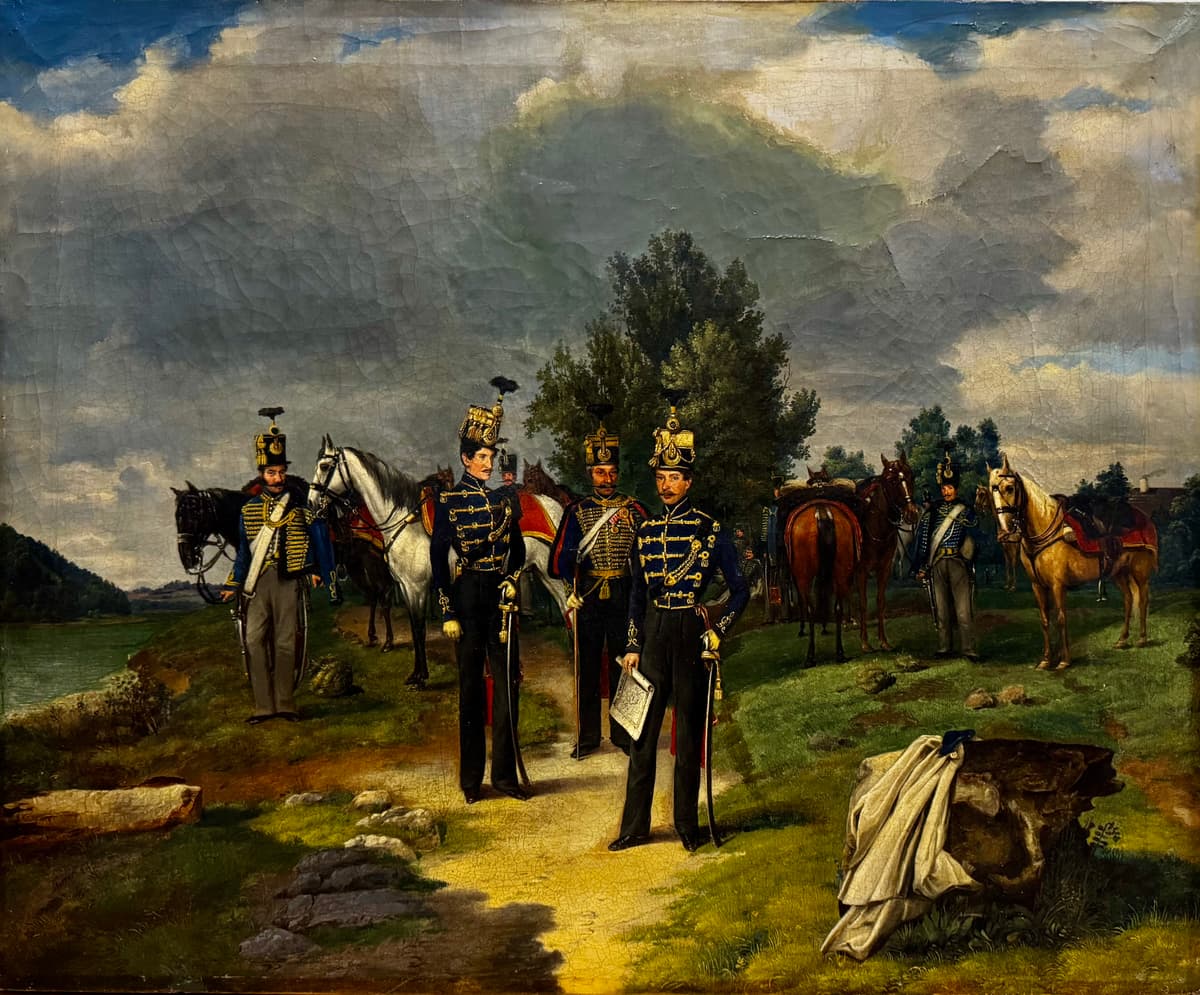
The painting depicts five hussars in uniform waiting on a rocky field near a riverbank, with hills visible in the distance. One figure in the background appears to be tending to horses. The hussars are shown during a rest period, either before or after receiving their orders. The central figure holds an official document, possibly a map. The cloudy sky suggests an ominous atmosphere.
The soldiers’ stoic, expressionless faces confront the viewer directly, while their horses are depicted in profile or from behind, filling the canvas’s empty spaces. The artist likely aimed to portray the hussars’ distinctive features and uniforms with precision, possibly fulfilling a commissioned work. Franz Sterrer also paid exceptional attention to the detailed rendering of their attire.
Franz Sterrer Biografhy
Franz Sterrer, was an Austrian painter of portraits and genre scenes. He was born in Wels (Upper Austria) on November 16, 1818. Pupil of Friedrich von Amerling, one of the most eminent 19th century portrait specialists, Franz Sterrer exhibited at the Vienna Academy of Art from 1840 to 1845. In 1848, he moved to Constantinople, where he produced several portraits commissioned by Sultan Abdülmecit I. There, he married a French woman. After completing his works for the Sultan, the couple returned to France and settled in Ecully, near Lyon, where he died on September 17, 1901.