Jankay Tibor (1899-1994)
Village Street
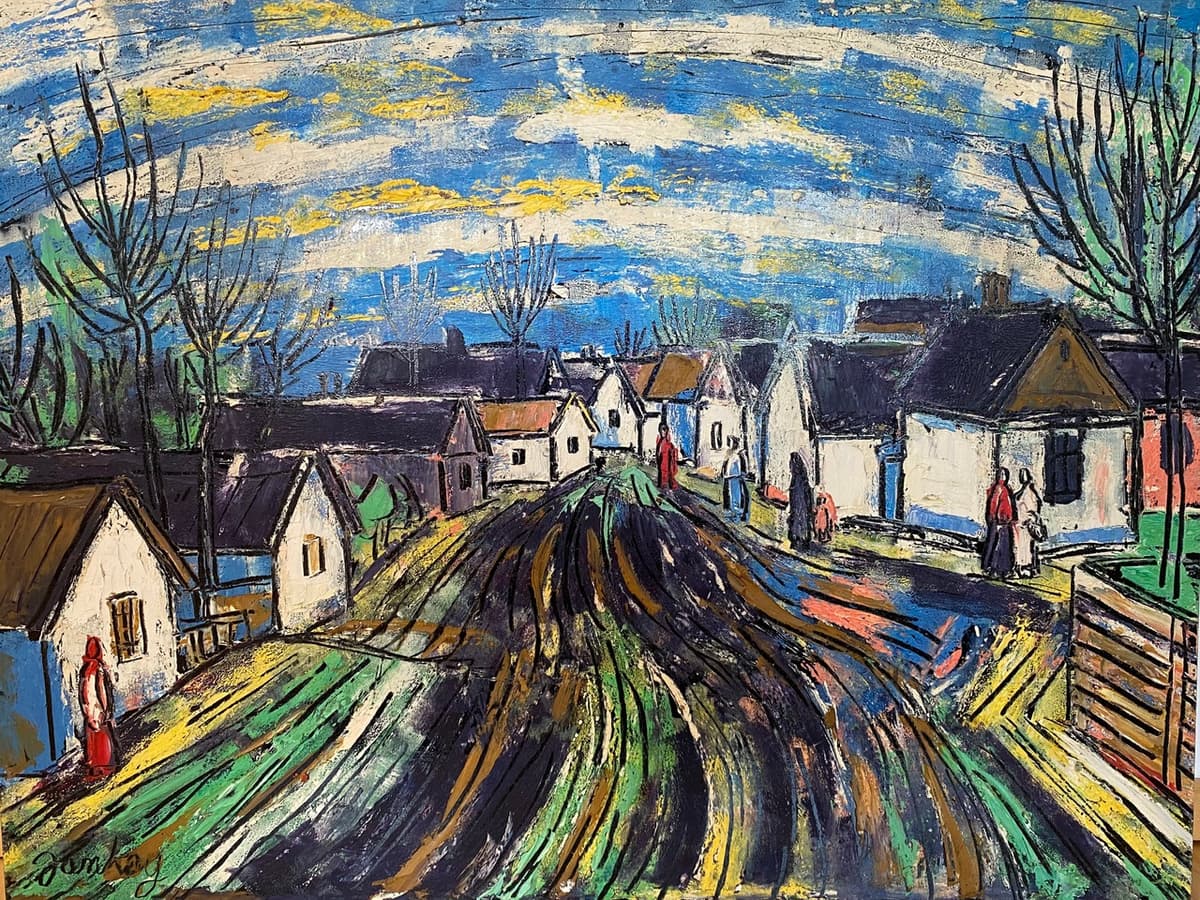
Description
No description available yet.
Curators
Ács Érmes Károly
curator
ermesprojekt@gmail.com
Detailed description
Tibor Jankay, born as Tibor Deutsch on March 24, 1899, in Békéscsaba as the fourth child of Simon Deutsch and Janka Löwy, in a family with six children.
He studied in Békéscsaba on Irányi Street, then at the Polgári Fiúiskola on Petőfi Street. From 1915 to 1918, he was a student at the Budapest School of Applied Arts. He was taught fresco painting by Sándor Papp and Béla Sándor, whose core idea of contouring and monumentalism accompanied his work throughout his career. From 1918 to 1919, he attended the Academy of Fine Arts, where he was taught by Pál Szinyei Merse and János Vaszary. In the 1920s, he participated in study trips across various parts of Europe, having visited Zurich, Dresden, Vienna, and Paris. In 1928-29, he traveled to Italy and then to America, where he visited his brother. He spent most of the 1930s in Hungary, where he had several exhibitions in Budapest and the countryside, featuring his graphics and paintings. At that time, Békés County was quite an artist-friendly place, thanks to the Aurora Circle, which also supported Jankay in his work. In the mid-1930s, he visited the overseas again.
Tibor Jankay with his wife
In the 1940s, he received several summons to labor camps. On his last journey, he escaped from the train, thus surviving the Holocaust. In 1948, he moved to America with his wife, Irén Alexander, where not only his brother lived but also his mother. His love for his parents justified his name change. Initially, he signed his works as Jankai-Deutsch Tibor or Jankai D. Tibor, and then in 1945 he adopted the name Tibor Jankay.
He settled in Los Angeles, where he worked as a university lecturer at George Pepperdine University and Redlands University. Alongside his painting and teaching activities, he created graphics and ceramics.
In 1975, his wife passed away, which affected him deeply. After retiring in 1977, he considered moving back home, but it remained just a plan. During this time, he discovered a "different America," a liberated, love-filled bohemian world. He walked the coastline, especially Venice Beach, which reminded him of the Great Plain and his youth. Until his death, he was characterized by vitality and a great desire to create.
He died on March 20, 1994, in Los Angeles. A documentary film about his life was directed by Harlan Steinberger, which won several awards.
His Work
His first significant works are remarkable graphics featuring contouring and strong tonality. He also presented drawings at the exhibitions of the New Society of Artists (KUT), of which he had been a member since 1926. Between the two world wars, his painting was characterized by a quest for direction. The horrors he experienced in labor camps were immortalized in his graphic album titled Martyrs, published in 1947, which was published by Tevan Publishing.
In his later period, a spirit of experimentation is observable, with recurring themes in his early sketches and the abundance of color. His style is a unique blend of European-rooted realism and constructivism, along with American abstract expressionism and pop art. His ceramics and sculptures are quality, matured works that reflect the influence of tribal art.