Kleitsch
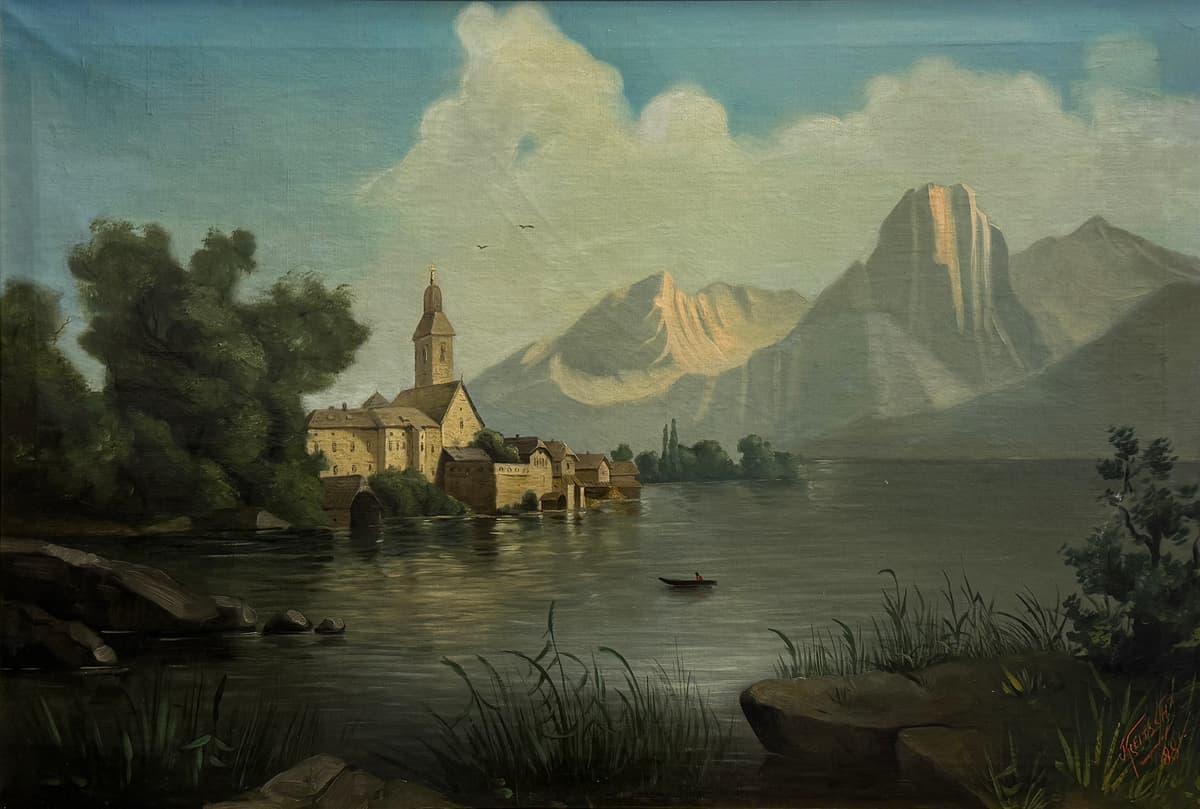
The Village’s Silent Mirror
Description
No description available yet.
Curators

Ács Érmes Károly
curator
ermesprojekt@gmail.com
Detailed description
Kleitsch's Art: A Pioneer of Central European Expressionism
Kleitsch (1890–1957) is one of the lesser-known yet fascinating figures in 20th-century Hungarian painting. He studied at the Academy of Fine Arts in Vienna, where he became acquainted with the possibilities inherent in expressionism and secession. In his early years, he created his first canvases in a circle of friends, which already aimed at the dynamic portrayal of colors and structures.
His oeuvre is divided into several well-defined phases: the intense experiments with forms and perspectives in the early years; the middle period, when Kleitsch turned to urban themes, creating a sharp contrast between the modern city and the traditional rural landscape; and finally, the series of meditative still lifes that began in the 1980s, where the artist explored the depths of the soul.
His most famous work, "Garden of Sunshine" (1924), is a masterpiece of playful pastel colors and dynamic brushwork. Also noteworthy is the "Blue City Morning" (1931), which evokes the cold zenith of the modern metropolis, as well as the late-period piece "Still Life with Red Desire" (1952), where the color contrast and minimalism open new dimensions.
Kleitsch's painting is characterized by a commitment to subjective experience and the underlying emotional content. His works always exhibit an inner tension, and the interplay of forms and colors creates a dramatic yet harmonious totality. Today, his works are mainly preserved in Central European collections and some private collections.
Kleitsch's legacy continues to inspire young creators who push the boundaries of color and form. His painting reminds us that the most important task of art is to capture and express the delicate vibrations of the human soul.