Rubint Ávrahám Péter
In the Shadow of the Black Line
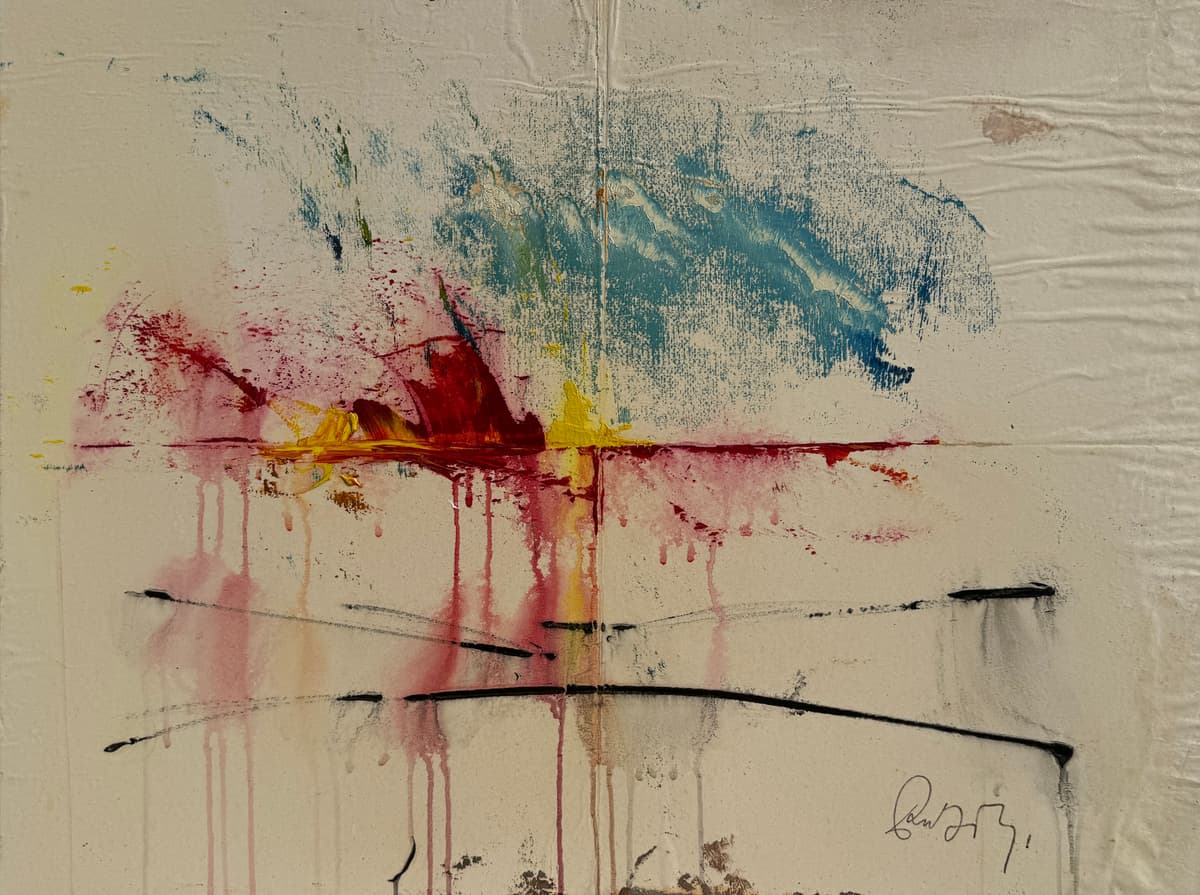
Description
No description available yet.
Curators

Ács Érmes Károly
curator
ermesprojekt@gmail.com
Detailed description
Overview of Péter Rubint Ávrahám's Art
Péter Rubint Ávrahám (1978–) is a Hungarian visual artist whose rich and diverse oeuvre has had a significant impact on contemporary visual culture. He began his artistic career at the Budapest Academy of Fine Arts, where he primarily studied the languages of abstract expressionism and minimalism. During his studies, he developed an interest in the fusion of colors and textures, which later emerged as a defining motif in his works.
In the early 2000s, Rubint held his first solo exhibition, where his painting series titled "Light Bridge" already demonstrated his unique perspective. Later, his art expanded to include sculptural and installation elements: in the installation titled "Play of Shadows", he experimented with light-shadow effects, while the works entitled "Atmospheres in Space" emphasized the contrast between organic forms and geometric structures.
His work is characterized by multimedia experimentation: through video projections and interactive elements, Rubint aims to engage the viewer in the creation of his artwork. His approach is defined by continuous transformation and the exploration of layers of perception, thus the fine nuances of color and form, as well as the tactile qualities of materials, are central in every new series.
Works by Péter Rubint Ávrahám are featured in numerous domestic and international collections, including selections from the Ludwig Museum and the House of Modern Art in Vienna. He has also received several awards, such as the National Cultural Fund scholarship and the Budapest Art Award. Throughout his career, he regularly conducts workshops and lectures, supporting the development of young creators.
Overall, the art of Péter Rubint Ávrahám builds on the harmony of colors, materials, and light, while continuously seeking new expressive possibilities. His creations evoke both inner landscapes and universal human sensations, allowing everyone to find their personal references and experiences within his works.