Zsolnay manufaktúra
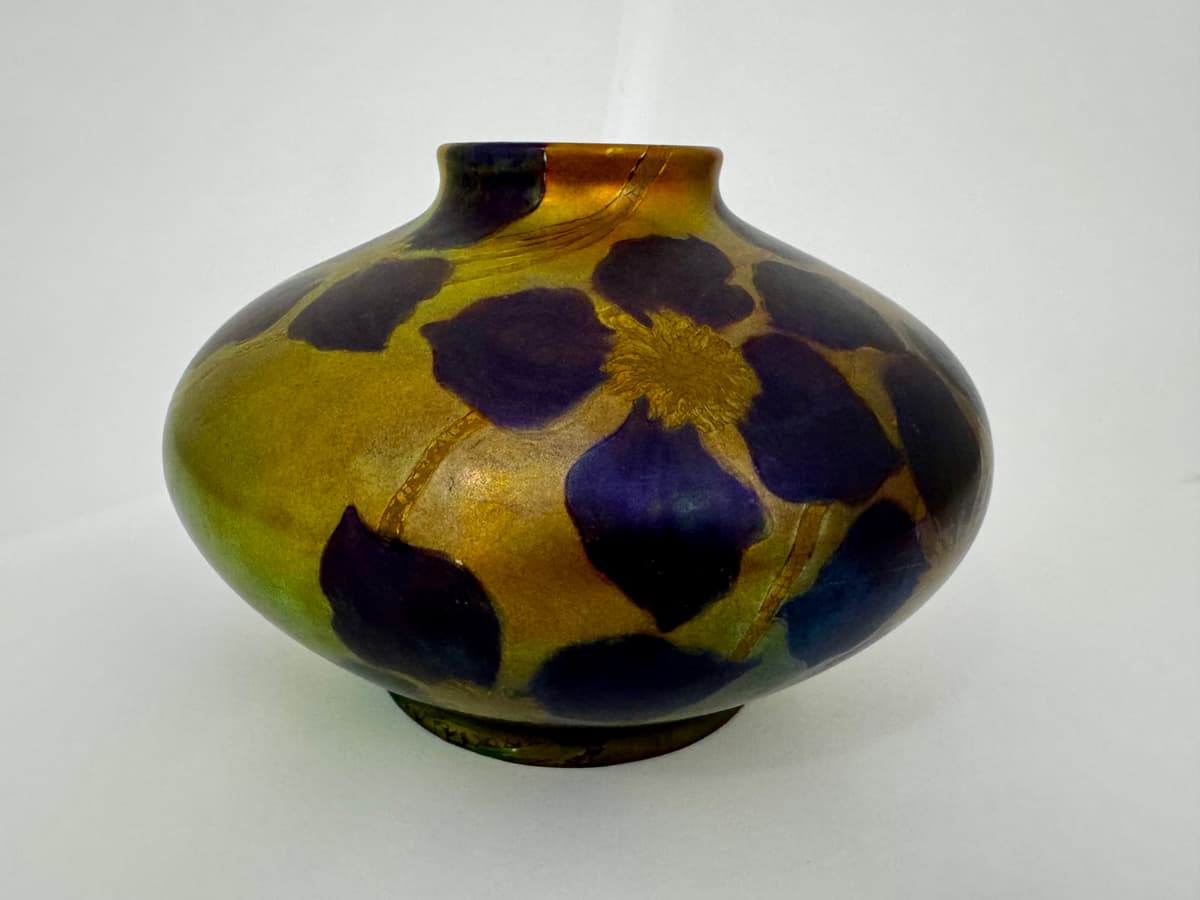
Zsolnay vase - With an elegant stylized floral pattern on its mantle
Description
No description available yet.
Curators

Ács Érmes Károly
curator
ermesprojekt@gmail.com

Matuszné Poltz Judit
curator
mpjuci@gmail.com
Detailed description
Introduction
The Zsolnay Manufactory has seen many excellent artists and technicians working within its walls since its foundation in 1853, but among them, Vilmos Zsolnay (1842–1900) stands out, having gained international fame for his originality and technical genius. Vilmos combined the traditions of traditional ceramics production with the latest chemical experiments, introducing innovations that fundamentally shaped the decorative and architectural ceramics of the era.
Career
Vilmos Zsolnay began his professional career alongside his father, Miklós Zsolnay, and soon created an independent laboratory where he tested hundreds of different oxide combinations. His most famous innovation is the eosin glaze, which, with its metallic sheen and variable color shades, revolutionized ceramic art from the end of the 19th century. Concurrently, he developed an outdoor ceramic material called pyrogranite, which provided high weather resistance and mechanical strength. Throughout his experiments, Vilmos always paid attention to the harmony of form and function, so Zsolnay ceramics served not only as decoration but also as architectural elements.
Works
Among Vilmos's works, the eosin-gloss vases presented at the 1885 Brussels World Exposition stand out, for which the Zsolnay Manufactory was awarded a gold medal. The pyrogranite bas-reliefs visible on the facade of the Vigadó in Budapest and the buildings of the Zsolnay Cultural Quarter in Pécs demonstrate the factory's technical innovations and aesthetic principles simultaneously. In addition, numerous decorative plates, decorative cups, and wall plates in the Secessionist style are attributed to his name, where motifs of nature and rich ornamentation appear in perfect harmony.
Legacy
The work of Vilmos Zsolnay influenced not only Hungarian but also European ceramic art development: his new processes and brilliant formal world have inspired the creators of Secession and Art Nouveau. The Zsolnay Manufactory still operates along the technical and aesthetic standards he established, and world-renowned works are preserved in the most significant ceramic collections worldwide. Vilmos's legacy lies in the combined strength of creativity and scientific precision, having a lasting impact across generations.