feltehetően Édouard Righetti (1924–2001)
Sorrentó
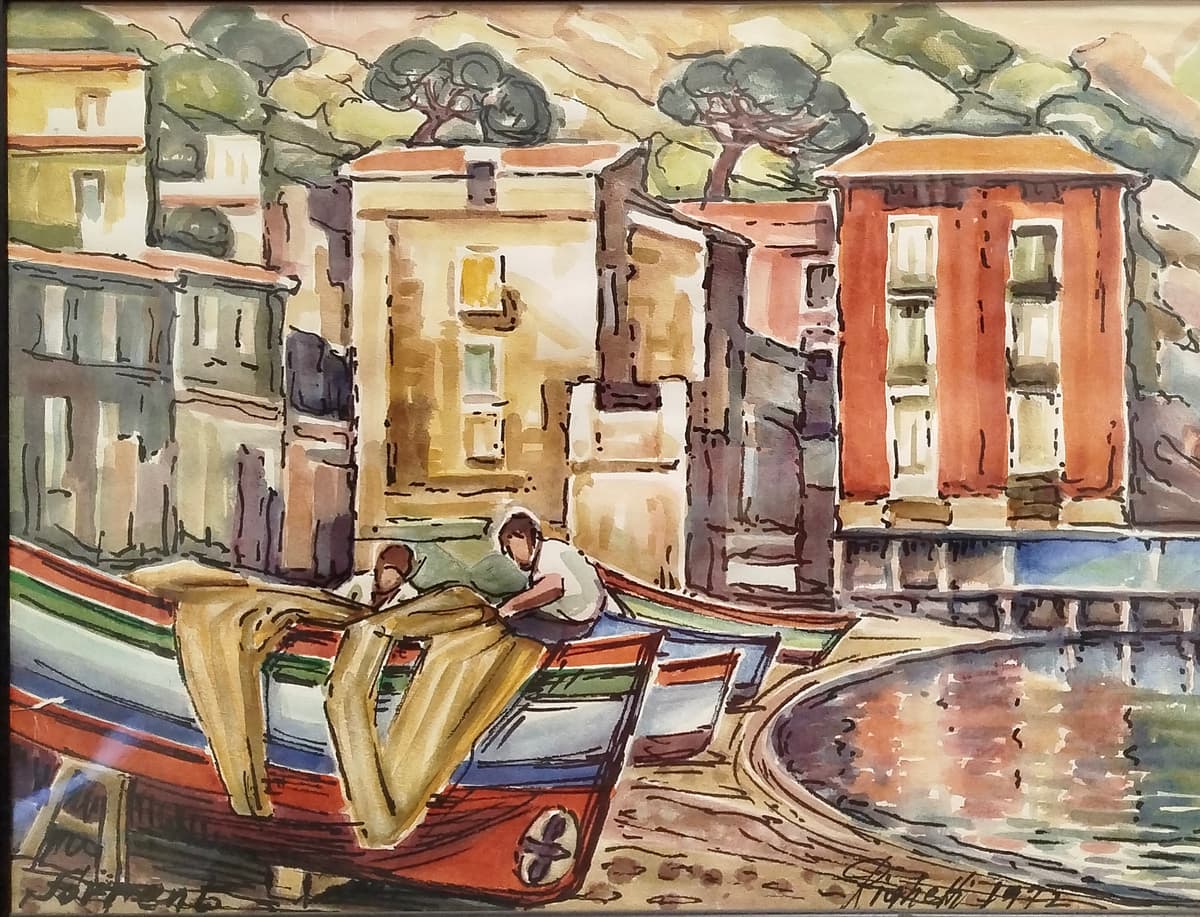
Description
No description available yet.
Curators

Ács Érmes Károly
curator
ermesprojekt@gmail.com
Detailed description
Édouard Righetti: His Life and Art
Édouard Righetti (1924–2001) was an exceptional artist of the 20th century, whose work combined classical traditions with postmodern experimentation. Born in Geneva in 1924, with Italian roots, he soon moved to Paris, where after completing his studies at the École des Beaux-Arts, he quickly found himself at the center of the artistic avant-garde.
Righetti's early works are rooted in portrait and landscape painting: his compositions, painted on oil canvas, employing fine light-shadow play received criticism with literary depth. In the 1950s, he made a new stylistic shift and turned towards geometric abstraction, where the dynamic interplay of colors and shapes became a guiding principle.
One of the artist's most well-known works, the 1962 canvas titled “Éclosion,” expresses the experience of internal transformation through the play of circular motion and vibrant blue-violet tones. By the 1980s, Righetti's works emerged in monumental installations: combining glass, steel, and neon, he built a spatial experience in galleries.
Throughout his career, Righetti exhibited at the MoMA in New York, the Venice Biennale, and the Milan Triennale. Through his teachings, he influenced generations: several of his students have become defining figures in contemporary art today.
Through his edge-tinged experiments and innovative approach, Édouard Righetti became one of the most exciting and still inspiring artists of the late twentieth century.