Feltehetően Julius Schmid (1854–1935)
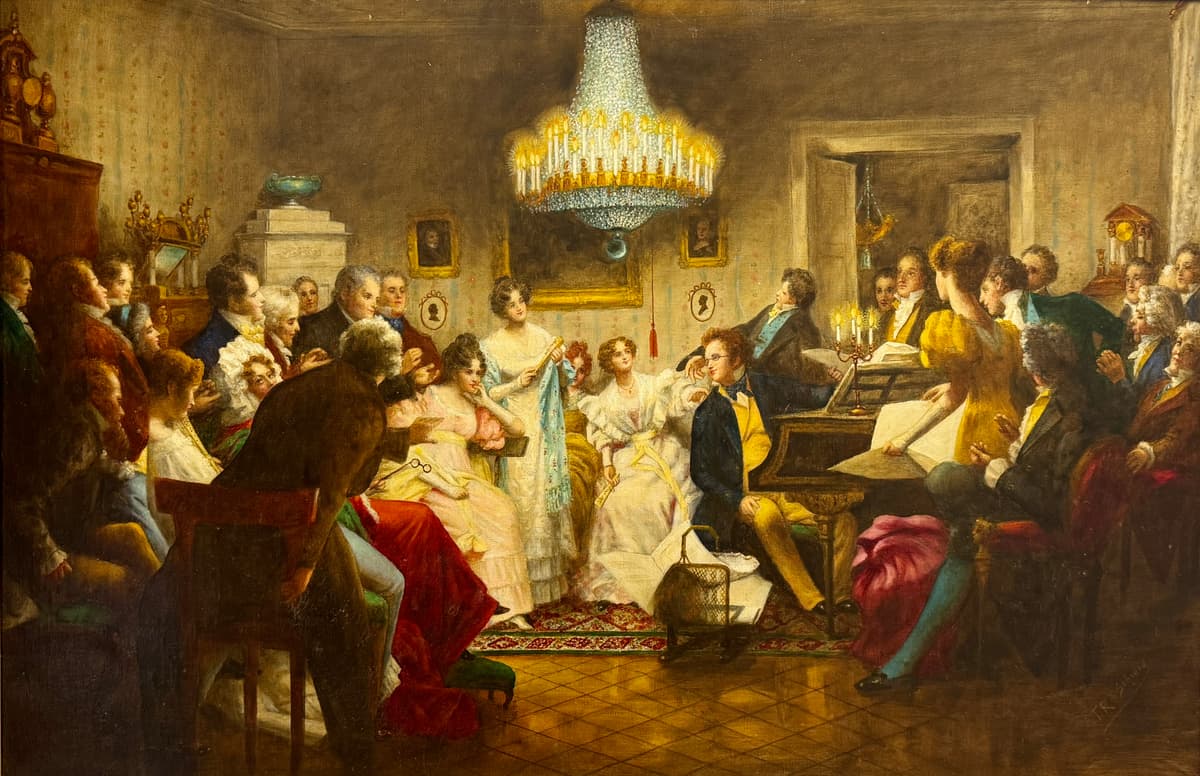
Schubert evening in a Viennese salon
Description
No description available yet.
Curators

Ács Érmes Károly
curator
ermesprojekt@gmail.com

Ohnhaus Éva
curator
eva.artdeco@gmail.com
Detailed description
Julius Schmid (1854–1935): the master of academic painting
The original oil painting: large size, canvas, owned by Wien Museum: 1897, oil, canvas, approx. 172×255 cm, location: Wien Museum (Karlsplatz), inventory no. 16843.
Julius Schmid was an Austrian painter born in Vienna in 1854. As a child of an artistic family, he was introduced to the basics of painting in a colorful environment at a young age. He studied at the Academy of Fine Arts Vienna, where the academic tradition and historical painting had a significant impact on his work.
Throughout his career, Schmid combined the historicism of the late 19th century with the mood of the fin de siècle. His works often feature allegorical themes, mythological figures, and rich, plastic female portraits. His creations are characterized by sensitivity to detail, subtle color tones, and compositional harmony, which earned his paintings wide recognition among contemporary art circles.
Among his well-known works are “The Allegory of Wisdom” (1890), which blends classical form language with modern sentiment, and “The Triumph of Virtues” (1901), which pairs moralizing themes with rich ornamentation. His paintings can be found in the Vienna Museum of Fine Arts and the Hungarian National Gallery, showcasing his versatility and technical virtuosity.
Schmid remained active in the early 20th century, although avant-garde movements overshadowed academic painting. Nevertheless, his works are still outstanding examples of classical imagery and fine tonal management. Julius Schmid passed away in 1935, but his legacy constitutes an important part of Vienna's art history.