Tihanyi János Lajos (1885–1938)
Quiet Foraging
Description
No description available yet.
Curators

Ács Érmes Károly
curator
ermesprojekt@gmail.com

Ohnhaus Éva
curator
eva.artdeco@gmail.com
Detailed description
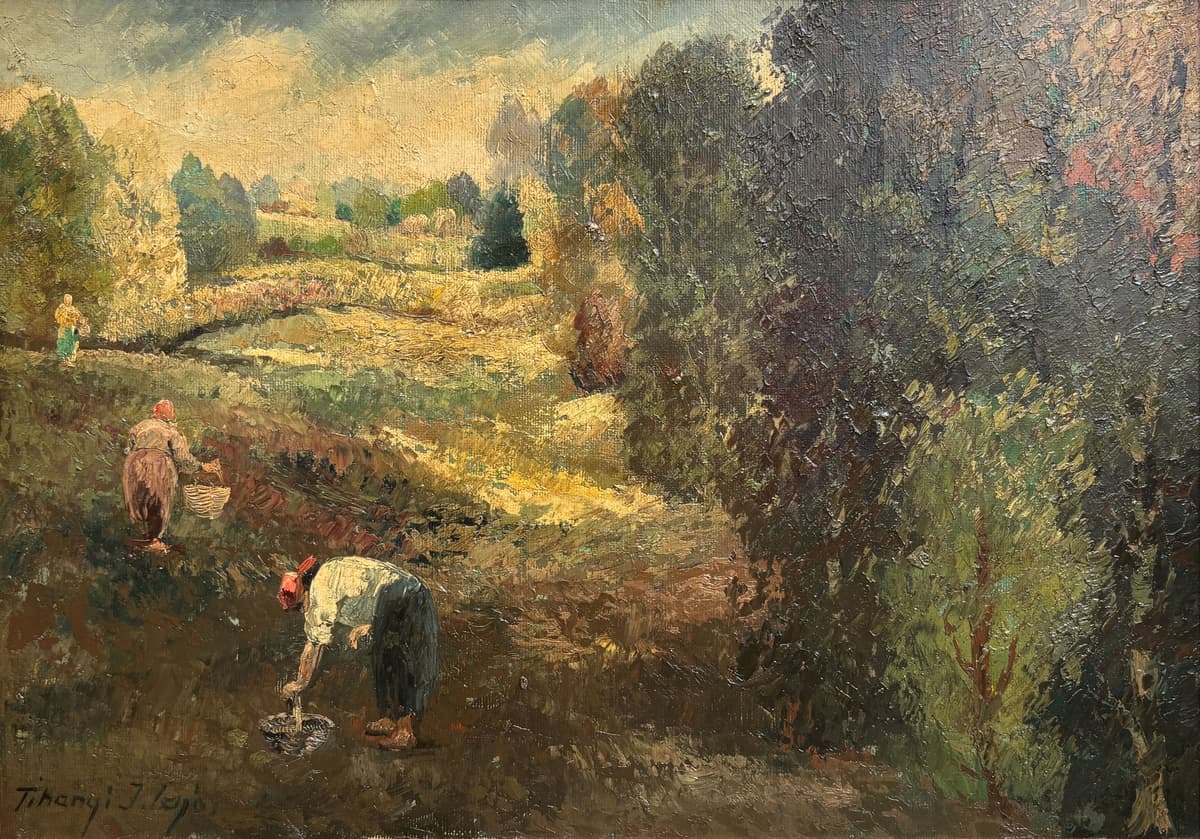
A spacious, gently sloping valley landscape where three peasant women are working: on the left and in the center of the foreground, they are foraging with baskets, while in the background, a fourth figure appears at the edge of the stream. The composition is surrounded on the left by an open meadow and a winding stream, and on the right by a dense, darkly layered wall of foliage. The light falls on the middle ground, with warm ochre-gold reflections, while the sky evokes a cloudy, gray-blue atmosphere before the rain. The color palette is based on earth tones (umbra, greens, ochres), occasionally accented with red on the headscarves. It is characterized by strong, pasty brushwork, spatula application, and scraping marks; the texture of the surface is particularly rich in the mass of foliage on the right. The clothing (headscarf, loose skirt, apron) and the woven baskets evoke peasant attire from 1900 to 1930. In its overall effect, it embodies plein air naturalism with post-impressionist texture; the likely decade of creation is the 1910s or 1920s.
Key details:
In the bottom left corner, marked in black paint: "Tihanyi J. Lajos".
Pasty, knife-shaped leafy surfaces on the right side.
Winding stream in the middle ground, meadow divided by light spots.
Foreground woman in a bowing pose, with a red headscarf and a woven basket.
Contrast of warm golden tones and a stormy, cloudy sky.
János Lajos Tihanyi. The marking "Tihanyi J. Lajos" visible in the image corresponds to this. Archival data is sporadic; the style of the work is plein air-naturalistic, with peasant genre, which differs from the modernist language of the well-known avant-garde Tihanyi Lajos (1885–1938), thus confusion should be avoided. He is likely a regional Hungarian painter from the early 20th century, with thick-textured landscape genres. For confirmation of authorship, a study of the signature and provenance research is recommended.