Lot details
Curators

Ács Érmes Károly
curator
ermesprojekt@gmail.com

Ohnhaus Éva
curator
eva.artdeco@gmail.com
Detailed description
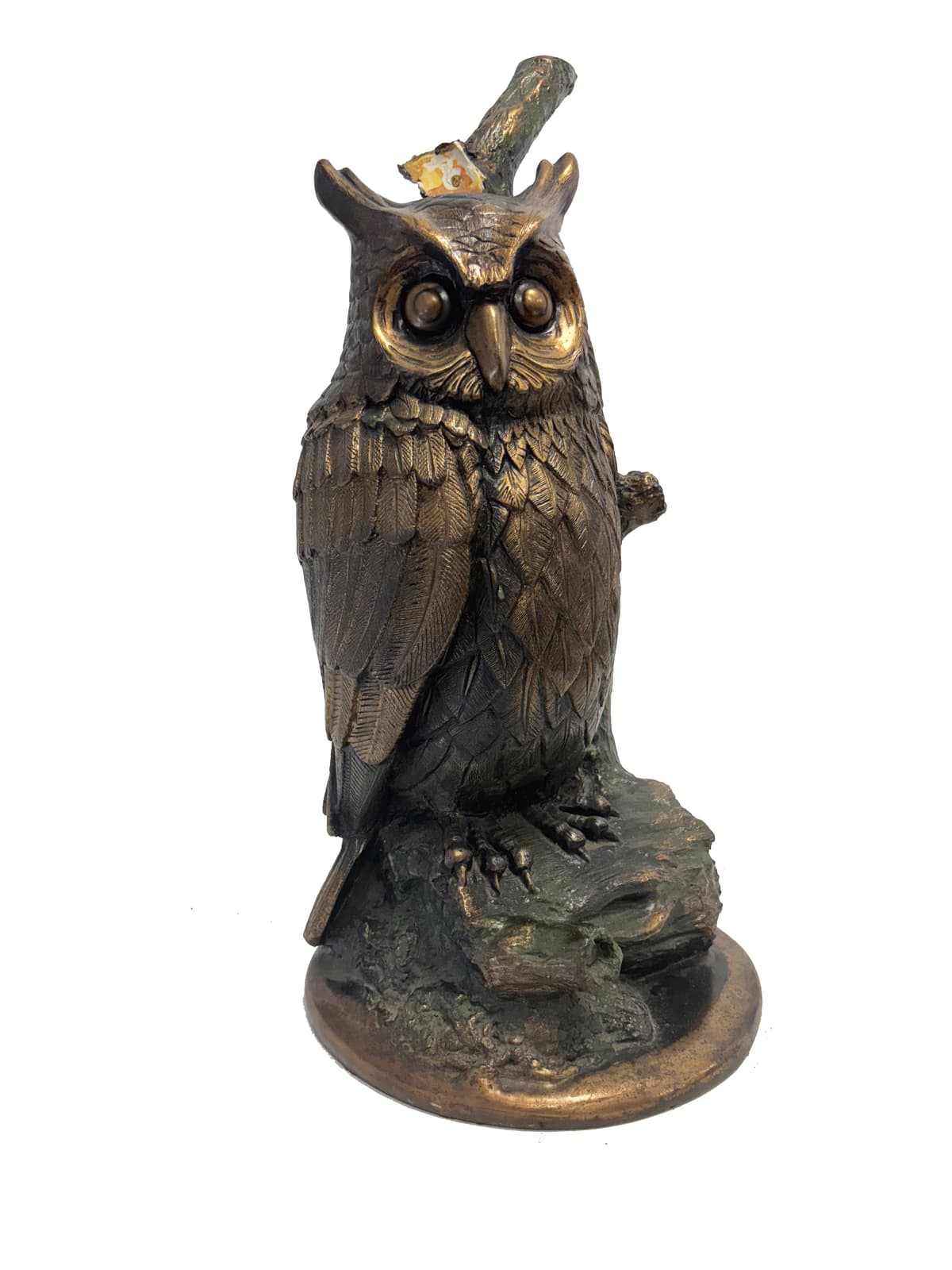
Large owl
Freestanding bronze sculpture of an owl on a circular base. The bird sits on a decayed tree stump, with a back that curves and reaches high with branches; the tip is broken, revealing a light, porous core material. The plumage is detailed with a repeating, V-shaped carving pattern; the wing covers and the chest are segmented into different layers. The eyes are hemispherical, prominent discs, creating a strong plastic effect that gives a decorative, slightly stylized gaze. The surface has a dark brown "bronze" tone, with occasional golden highlights and an artificial greenish patina on the base; this indicates a painted/cast surface. The composition is frontal, with a slightly S-curved posture; beyond the material flaws, there are no visible casting marks. Size: approx. 59.5 × 27 cm. Iconography: great horned owl (Bubo virginianus/European relative), a symbol of wisdom. The craftsmanship resembles industrial casting; probable material: "cold-cast bronze" (polyresin coated with bronze powder), late 20th – early 21st century, approximately 1990s–2010s, decorative animalier-naturalism.
Key details:
Broken branch behind the crown, with light core material
Large, disc-like eyes, pronounced eyebrow arch
Detailed, repeating feather structure
Greenish patina effect on the base
Circular base, cast in one piece
Author Identifications
No named creator; the object gives the impression of being a series-produced, decorative small sculpture. The following names serve as stylistic references, not attributions:
Franz Xaver Bergman (active: around 1880–1930) – the owl figures of "Vienna bronze" provide an iconographic precedent, but here the material and size differ.
Irénée Rochard (1920–1980s) – animalier themes, detailed surface treatment; his modeling is more plastic in bronze.
Jules Moigniez (active around 1855–1894) – naturalistic feather drawing; 19th-century bronzes show finer casting marks.
Pierre-Jules Mène (1830–1870s) – classical compositions of animal sculptures; the objective, decorative execution of the present work is different.
Antoine-Louis Barye (1820–1860s) – source of the animalier tradition, with iconographic influence.