Lot details
Curators

Ács Érmes Károly
curator
ermesprojekt@gmail.com

Ohnhaus Éva
curator
eva.artdeco@gmail.com
Detailed description
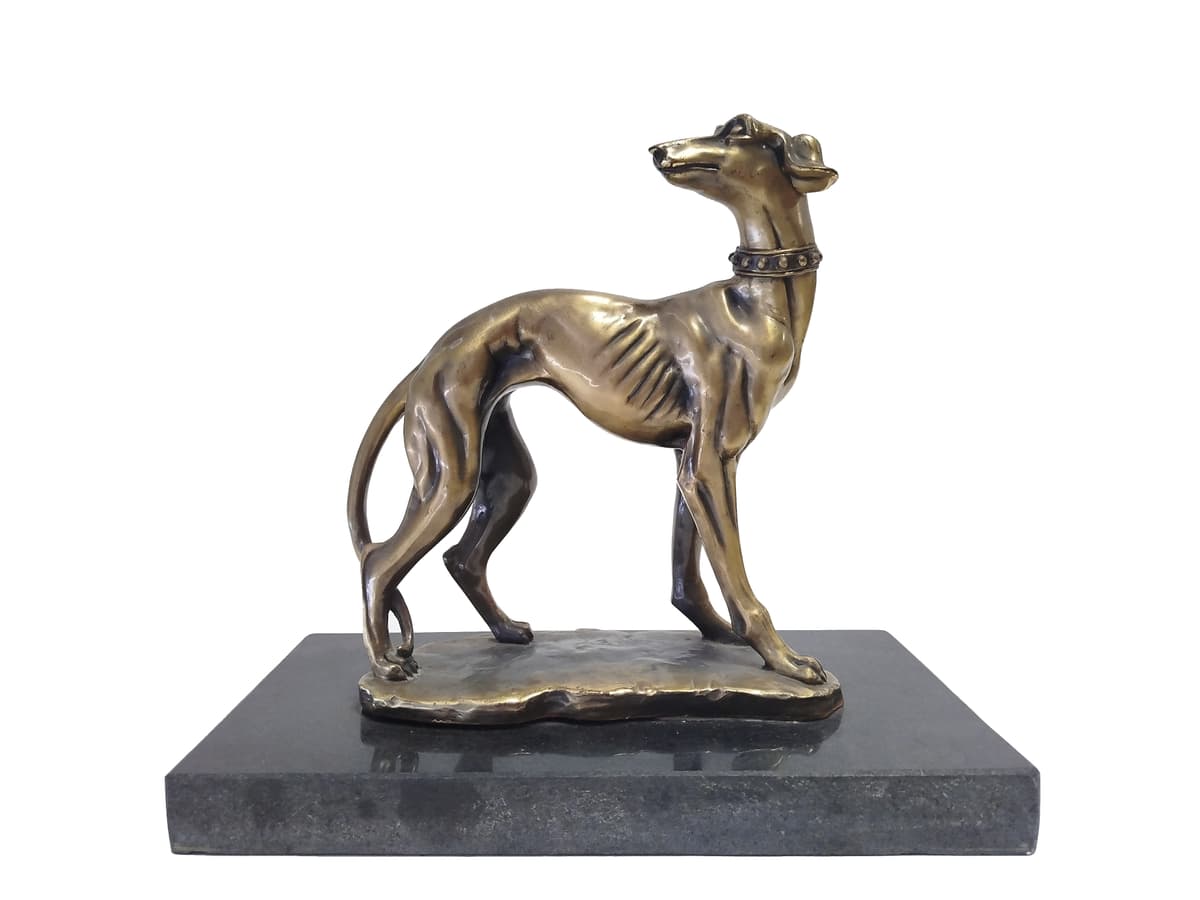
The small sculpture depicts a slim greyhound with its head held high, in a watchful posture. The composition is based on a side view, with the body's curves guiding in an S-shape from its proud neck to the arched curve of its tail. The material is bronze, with a warm, golden patina; the convex surfaces are worn to a shine, while the recesses are darker, creating a strong contrast of light and shadow. The muscles and ribs are worked in a plastic, slightly stylized manner, with the simplified masses of the head and ears approaching the animal sculpture tradition, yet leaning towards the purity of 20th-century Art Deco. The studded collar evokes a noble, hunting milieu; the organic pedestal shape is natural, while the polished dark stone base adds a modern emphasis. The size is approximately 27.5 x 29.5 cm, suitable as a decorative sculpture for interiors. Overall, this work exists at the intersection of the French animalier tradition and Art Deco (1920s–1930s).
Key details:
Elegant, elongated proportions, S-curve composition
Warm golden-brown patina, with dark recesses
Characteristic greyhound head, simplified ears
Studded collar, hunting reference
Organic bronze base and separate dark stone pedestal
Attribution Candidates
No named creator; possible attribution candidates based on style and theme choice:
Irénée Rochard (active: 1920–1970) – Art Deco animal sculptures, slender, elegant dog depictions.
Max Le Verrier (1920–1940) – decorative Art Deco bronzes, often with marble bases.
Pierre Chenet (1940–1970) – elegant, slightly stylized animal figures, with warm patina.
Édouard-Marcel Sandoz (1910–1940) – simplified, stylistically pure animal sculpture.
Circle of François Pompon (1920–1930) – reduced forms, smoothed surface treatment.
Gaston d’Illiers (1890–1930) – hunting themes, greyhounds and horses in naturalistic formulation.
Circle of Pierre-Jules Mêne (1830–1870) – classical animalier, although this piece shows a more modern stylization.
Jean de Roncourt (1920–1935) – Art Deco animal forms, with pronounced body curves.
Among those listed, the French Art Deco circle of the 1920s–30s seems the most probable.