Lot details
Francia manufaktúra - pontosan nem ismert.
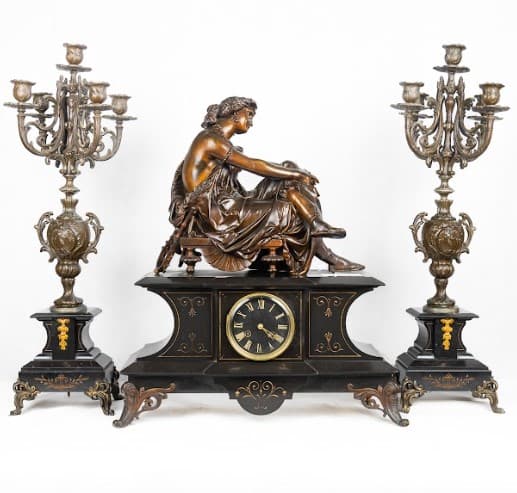
#54Three piece bronze patinated metal mantle clock set on marble base
Curators

Ács Érmes Károly
curator
ermesprojekt@gmail.com

Ohnhaus Éva
curator
eva.artdeco@gmail.com
Detailed description
Three-piece French candelabra set: a table clock built from black Belgian slate in the center, topped with a warm brown patinated, classicizing seated female figure, which adjusts her sandal at her foot. The sculpture features finely modeled curls, richly draped clothing, and intricately marked jewelry; the surface is smoothed, polished in places to a shine. The clock case is decorated with voluted side curves and gilded, stylized ornamentation; the black dial displays gold Roman numerals, Breguet-style hands, and two winding openings, indicating a spring-driven striking and walking mechanism. The pair of candelabra has bodies made of bronzed elements with cartouches and masks; the multi-branched arms bend in an S-curve, closed by acanthus leaves and drip plates. The composition is symmetrical, with a strong contrast between black and bronze; the decoration shows signs of neobaroque/rococo revival. Style period: French Second Empire/Napoleon III decorative bronze, likely from the 1860s–1880s.
Key details:
Patinated bronze seated female figure with classicizing clothing and jewelry.
Black Belgian slate clock case with gilded copper inlays.
Black dial with gold Roman numerals, openings indicating a key-wound spring mechanism.
Two candelabra, approximately 67 cm tall, with 6–7 branches and acanthus arms.
Voluted base, red copper/ormolu corner mounts, stylistically Napoleon III.
Attribution candidates
No named creator; possible French sculptor/bronzier workshops from the period:
Mathurin Moreau (active: 1850–1910) – classicizing female figures, soft drapery and jeweled figures.
Auguste Moreau (1860–1910) – romantic female figures, delicate facial modeling; often clock sets.
Hippolyte Moreau (1860–1910) – decorative, allegorical female figures, warm brown patina.
Émile Louis Picault (1860–1915) – allegories, characterful hand and foot modeling, detailed garment drapery.
Albert-Ernest Carrier-Belleuse (1850–1887) – lush rococo-revival decorations, elegant female figures.
Eugène-Antoine Aizelin (1860–1890) – academic female figures, bronzes applied on clock cases.
Raingo Frères (1830–1880) – renowned bronzier/clock case; frequent use of black slate and patinated figures.
Barbedienne workshop (1850–1900) – quality castings, uniform brown patina, fine finishing work.
Japy Frères or Vincenti & Cie (1850–1900) – characteristic structure suppliers; stamp often found on the back of the work.