Lot details
Curators

Ács Érmes Károly
curator
ermesprojekt@gmail.com

Ohnhaus Éva
curator
eva.artdeco@gmail.com
Detailed description
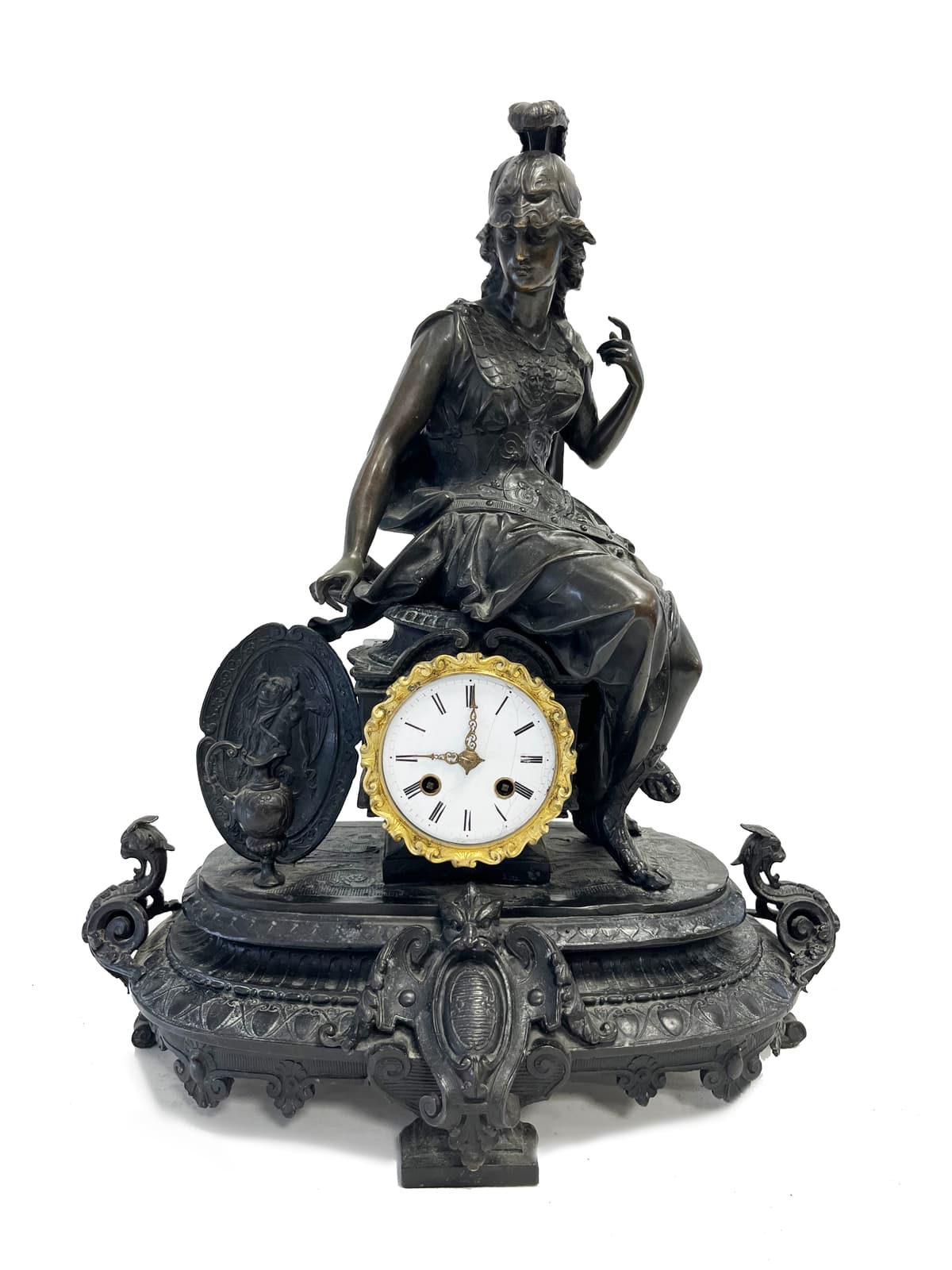
Monumental, approximately 49 x 41 cm mantel clock, with a central white enamel dial and richly cast figurative case. The composition is dominated by a seated woman in a helmet, adorned with scale armor and Gorgon-head decoration – the iconography refers to Minerva (Athena). The figure appears with delicately modeled facial features and softly flowing drapery; the movement is relaxed, with the right hand elegantly raised. The dial is made with Roman numerals, two winding openings, and a gilded, rocaille-profiled brass frame. The dark brown-black patina has become shiny in places, showing minor surface abrasions, with hairline cracks visible on the enamel. The pedestal features neo-Renaissance ornamentation: grotesque masks, volutes, palmettes, and a bead string running around it. On the left side, an oval relief shield and a small amphora appear, reinforcing the ancient theme. The material is likely patinated cast zinc (regule) with bronze fittings, related to the workshop of Japy Frères. Style direction: Napoleon III-era historicism, neo-Renaissance; likely decades: 1860–1880.
Key Details:
Plume-crowned Corinthian helmet and scale armor
Gorgon-head relief on the breastplate
White enamel dial with Roman numerals, two winding openings
Gilded, rocaille rim ring
Grotesque mask-themed neo-Renaissance pedestal; oval relief and small jug
Named creator: The circle of Japy Frères. Japy Frères & Cie was one of the industrial pioneers of French clockmaking (from the early 19th century to the early 20th century), with its headquarters in Beaucourt. Their series-produced, award-winning movements were incorporated into ornate historicist houses by Parisian bronziers and casemakers (e.g., Lemerle-Charpentier, Raingo Frères, Denière, etc.). The iconography and case design of the present piece fits into the repertoire of these Parisian workshops, and the movement is presumably made by Japy.