Lot details
Curators

Ács Érmes Károly
curator
ermesprojekt@gmail.com

Ohnhaus Éva
curator
eva.artdeco@gmail.com
Detailed description
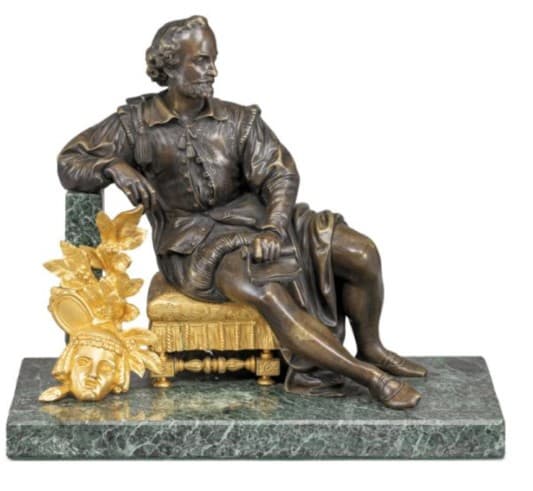
Patinated and partially gilded bronze small sculpture on a green marble base. At the center of the composition sits a bearded male figure holding a book on a decorative, tasseled cushion; he rests his right arm on a marble elbow rest. His attire has a Renaissance/Elizabethan character: a decorative stitched, buttoned dolman, puffed sleeves, shoulder straps with tassels, striped trousers, and pointed shoes. The shaping of the form is finely chiseled, with textures (curls, embroideries, tassels) carefully distinguished by post-processing. The contrast between the dark brown patina and the gilded details (cushion, theatrical trophy: leaves, ribbons, mask) creates a festive effect. The handling of light and shadow is soft, and the surfaces are polished to a slight shine. The object’s iconography – book and stage attributes – suggests an allegorical portrait of a humanist/playwright. The marble base is approximately 20×26 cm, and the total height is about 30 cm. Style: French Academism, period of the Second Empire–Third Republic; likely decades: 1880s–1900s.
Key Details:
Patinated bronze, partial gilding (parcel-gilt) and green marble base
Renaissance attire with tassels, embroideries, striped trousers
Book in the lap – literary/creative attribute
Gilded theatrical trophy with mask and laurel motifs
Careful chiseling, salon bronze quality, approx. 30 cm high
Author Candidates
No named creator; possible French sculptors from the era:
Albert-Ernest Carrier-Belleuse (active: 1848–1887) – Decorative, Renaissance-inspired figures and partial gilding suit the object.
Mathurin Moreau (1822–1912) – Salon bronzes, fine chiseled work, frequent marble bases and gilded elements.
Hippolyte Moreau (1832–1927) – Allegorical, literary themes; soft modeling and elegant poses.
Émile Guillemin (1841–1907) – Rich decoration, precise details in historical costumes.
Étienne-Henri Dumaige (1830–1888) – Historical and theatrical themes, academic formulation.
Louis-Ernest Barrias (1841–1905) – Academic finesse, frequent gilded details.
Paul Dubois (1829–1905) – Renaissance taste male figures, elegant proportions.
Jean-Baptiste Auguste Clésinger (1814–1883) – Distinctive portrait character and rich surface treatment.
Émile Pinedo (1840–1916) – Decorative bronzes, with marble base, partial gilding.
Susse Frères/Barbedienne workshops (foundries) – Leading casters of the era; attribution can be narrowed in case of a mark.