Lot details
Curators

Ács Érmes Károly
curator
ermesprojekt@gmail.com
Ohnhaus Éva
curator
eva.artdeco@gmail.com
Detailed description
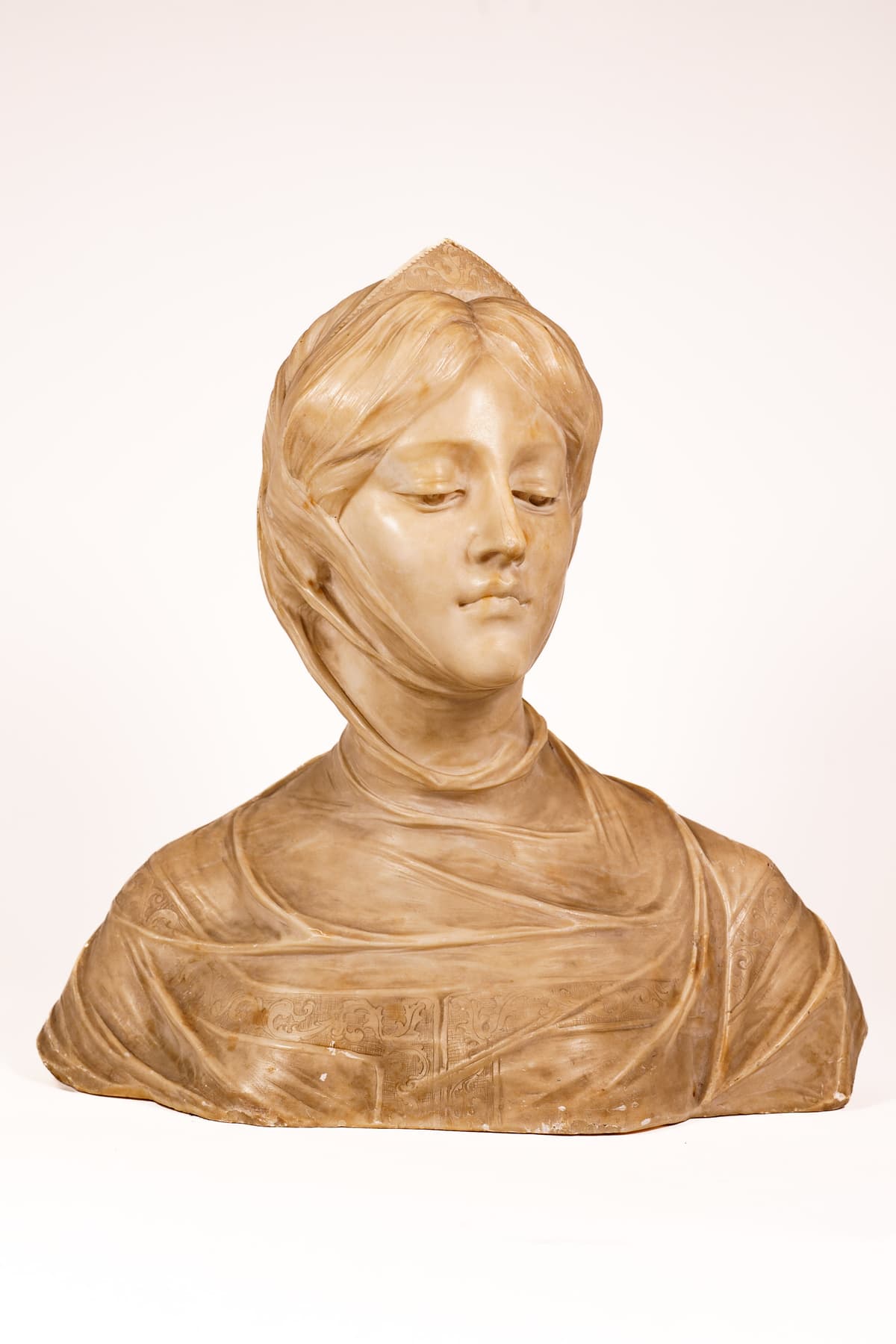
Half-length female bust, with a head slightly turned to the right and a downcast gaze. The composition is compact and balanced; the veil hugging the head and the wide, ridged cloak frame the face with large, soft drapes. The surface has received a warm, honey-colored patina; shiny polished areas alternate with matt, stone-like parts on the skin. The hair is delicately striped, with the parting and locks showing deliberate sculptural tool marks left intentionally. Shallowly carved, Renaissance-inspired arabesque patterns run along the decorative borders of the bust; a diadem-like band appears at the crown of the head, also adorned with engraved ornamentation. The face has an idealized, restrained smile; the soft transitions of the eyelids and the bridge of the nose indicate careful modeling. Based on the photos, the material appears to be patinated plaster or a faux alabaster; small chips and retouching marks can be detected on the lower edge. Overall, it represents neo-Renaissance and fin-de-siècle salon sculpture, likely based on a model from the 1890s to 1910s, in a later reproduction.
Key Details:
Idealized female face with a downcast gaze and fine polish
Diadem and Renaissance-inspired carved decorative border
Rhythm of softly falling, wide draperies
Warm, uniform, stone-like patina
Smaller chips and wear on the edges
Attributed Authors
Named attribution: After Antonio Frilli (1860–1920). Frilli was a Florentine sculptor and workshop leader, whose elegant salon busts and Renaissance and allegorical female figures were created for the international audience of the Grand Tour era in marble, alabaster, and patinated plaster. The "— after" designation usually refers to a later, outside or posthumous reproduction of one of Frilli's popular models, often from the first third of the 20th century.