Lot details
Curators
Ács Érmes Károly
curator
ermesprojekt@gmail.com
Ohnhaus Éva
curator
eva.artdeco@gmail.com
Detailed description
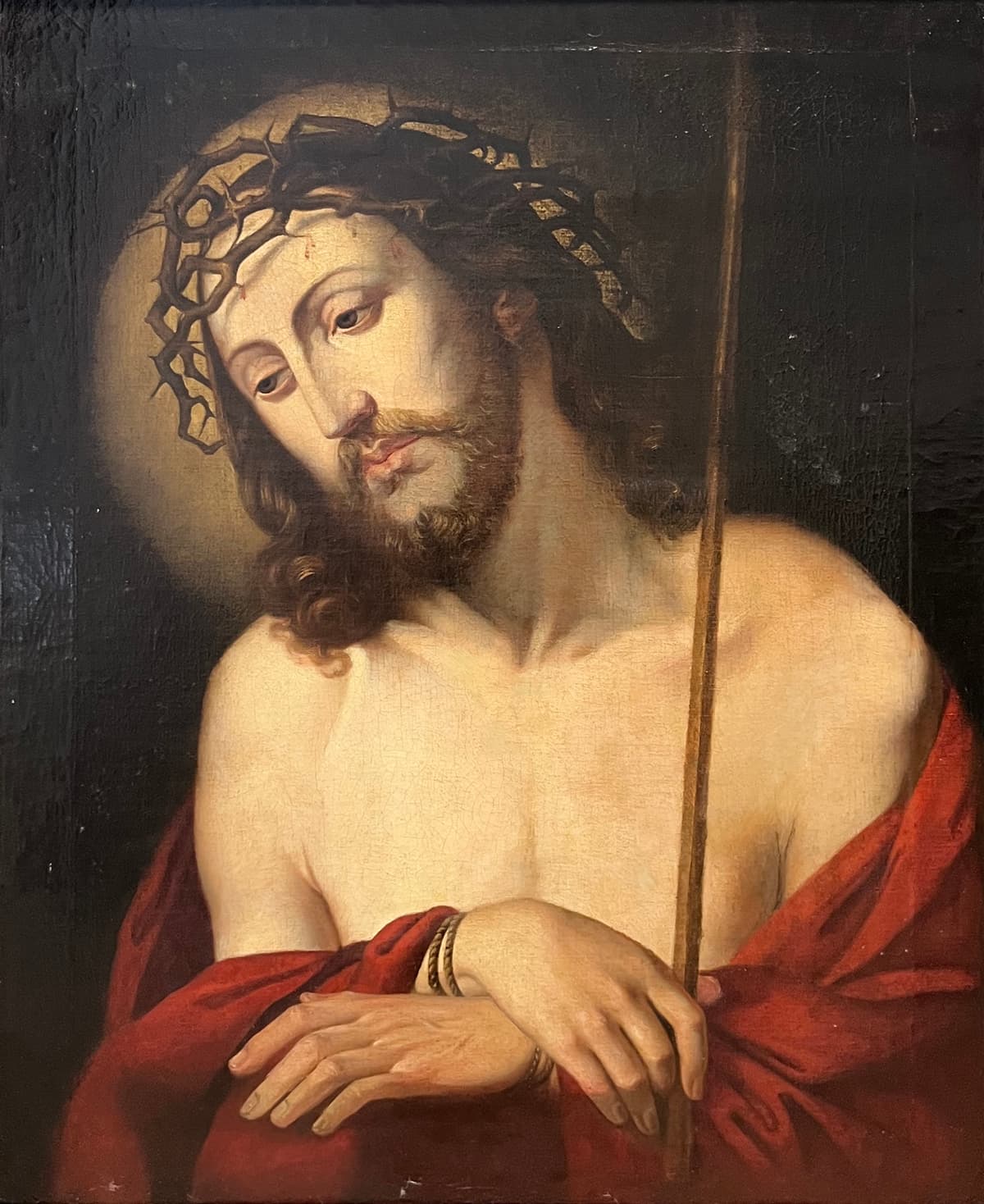
Half-length Ecce Homo representation: the Savior turns left in three-quarter profile, wearing a crown of thorns and a delicate, luminous halo. The background is dark and homogeneous, from which the pale, warm-toned body emerges plastically. The skin shows a dense, natural network of cracks; the painting is finely layered, characterized by thin glazes and soft sfumato, especially on the face and strands of hair. The red cloak is composed of solid, velvety reds with deep shadows; the hands are slender, with carefully drawn phalanges, held together by a rope. On the right side runs a reed, which is an iconographic element of the passion. The crown of thorns is stylized, consisting of angular parts, and the face has a melancholic, downcast gaze. The composition is devotional in purpose, and the light-shadow contrast is restrained. Dating: Italian-Flemish influenced Renaissance-early Baroque type, likely following a prototype from between 1550 and 1630.
Key Details:
Soft sfumato on the face, delicate rosy glazes
Stylized, geometric crown of thorns and beading drops of blood
Deep, black-tinged shadows in the drapery folds of the red cloak
Slender hands crossed with rope
Dark, uniform background and a golden halo
Author Candidates
No named creator; possible author candidates and their circles:
Bernardino Luini (active c. 1500–1532) – Leonardo's gentle facial type and soft modeling, Christ motifs in red cloaks.
Giampietrino, or Giovanni Pietro Rizzoli (active c. 1510–1549) – Leonardesque half-length saints, soft transitions, almond-shaped eyes.
Joos van Cleve's circle (active c. 1511–1540) – devotional half-lengths, precise hand drawing, dark background.
Adriaen Isenbrandt's workshop (active c. 1510–1551) – Flemish fine detailing, polished surface, stylized crown of thorns.
Luis de Morales, El Divino (active c. 1546–1586) – melancholic type of Ecce Homo, sensitive facial expression.
Guido Reni's circle (active c. 1595–1642) – noble idealization, slight chiaroscuro, Christ with head bowed.
Carlo Dolci (active c. 1635–1686) – extremely smooth surfaces, devotional intensity; later, but similar in composition.
Palma il Giovane's circle (active c. 1570–1628) – early Baroque Venetian half-length passion themes.
Quentin Massys' workshop/circle (active c. 1500–1530) – Northern type Christ face and hand forms.