Lot details
Curators

Ács Érmes Károly
curator
ermesprojekt@gmail.com

Ohnhaus Éva
curator
eva.artdeco@gmail.com
Detailed description
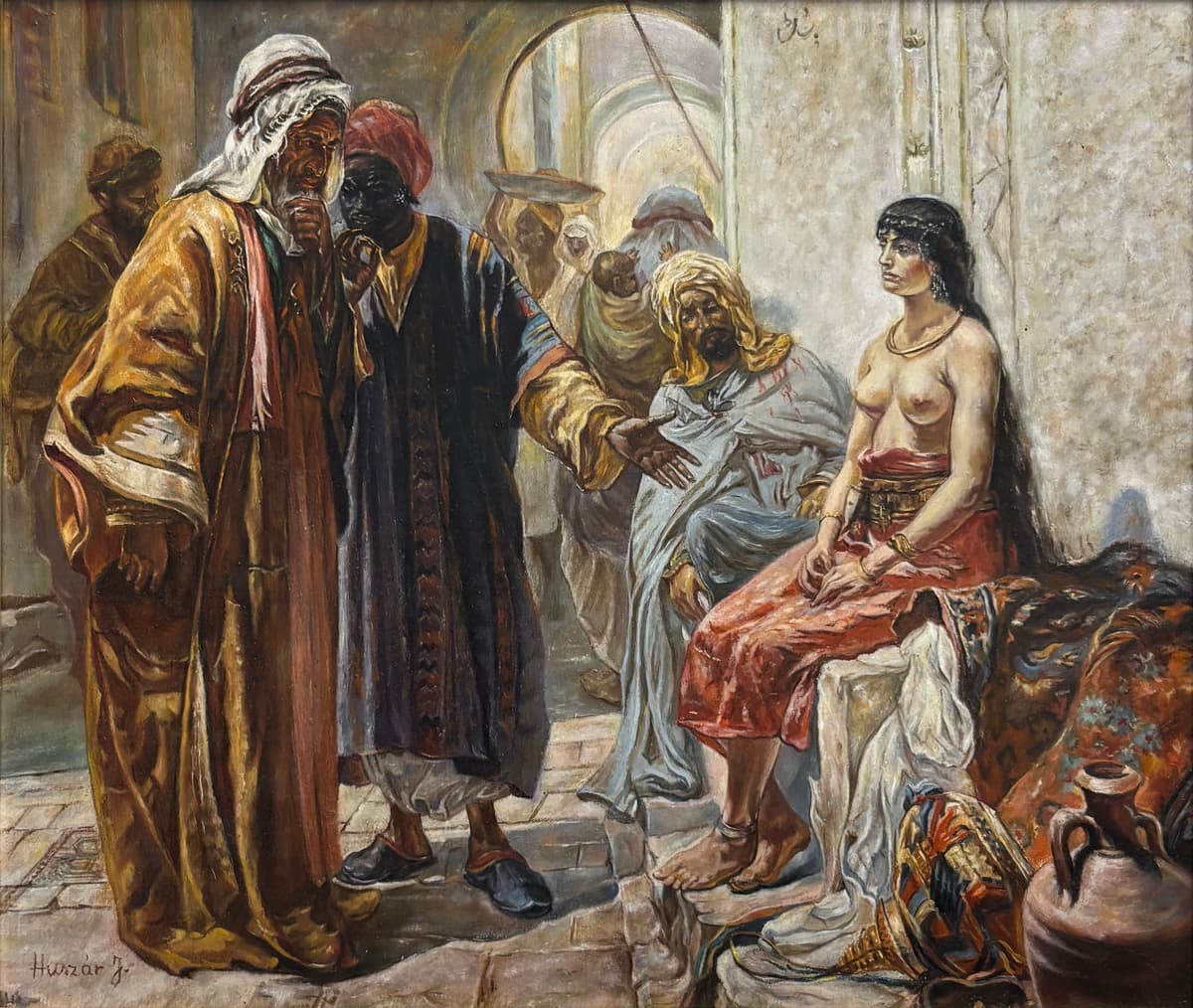
The composition depicts an oriental market scene: on the left, two merchants are engaged in discussion, in the center, a gesticulating figure points to the right, where a semi-naked, jewel-adorned young woman sits on a curb covered with carpets and textiles; in the foreground, a glazed clay pot. In the background, the arcade corridor and a dense, shadowy crowd deepen the space. The color palette is built from warm ochres, reddish browns, and earth tones, counterbalanced by cool grays and blue reflections. The brushwork varies: the folds of drapery and the textures of the turbans are modeled fluidly, while the skin surfaces are painted with a finer, smoothing technique. Light-shadow contrast guides the gaze to the figure of the woman and the gesture. The clothing – caftans, burnous, turban – and the eastern accessories evoke the Orientalist iconography of the late 19th century to early 20th century. Overall impression: academicizing-Orientalist genre; likely creation period: 1900s–1930s.
Key Details:
In the lower left corner, the inscription "Huszár J."
Arcaded architecture with deeper perspective
Rich, golden-brown robes and contrasting red turban
Seated woman on the right with gold necklace and bracelets
In the foreground, oriental carpets and ceramic pot
Author Indications
Based on the inscription "Huszár J." visible in the lower left corner, the creator is presumably a Hungarian painter within the academicizing-Orientalist tradition of the turn of the century. The name form could correspond to several less documented masters today; the stylistic features (genre-orientalism, detailed drapery treatment, epic narration) can be linked to early 20th-century workshop and academic training. Accurate identification may be clarified through archival and auction records, as well as comparative signature analysis.