Lot details
Curators

Ács Érmes Károly
curator
ermesprojekt@gmail.com

Ohnhaus Éva
curator
eva.artdeco@gmail.com
Detailed description
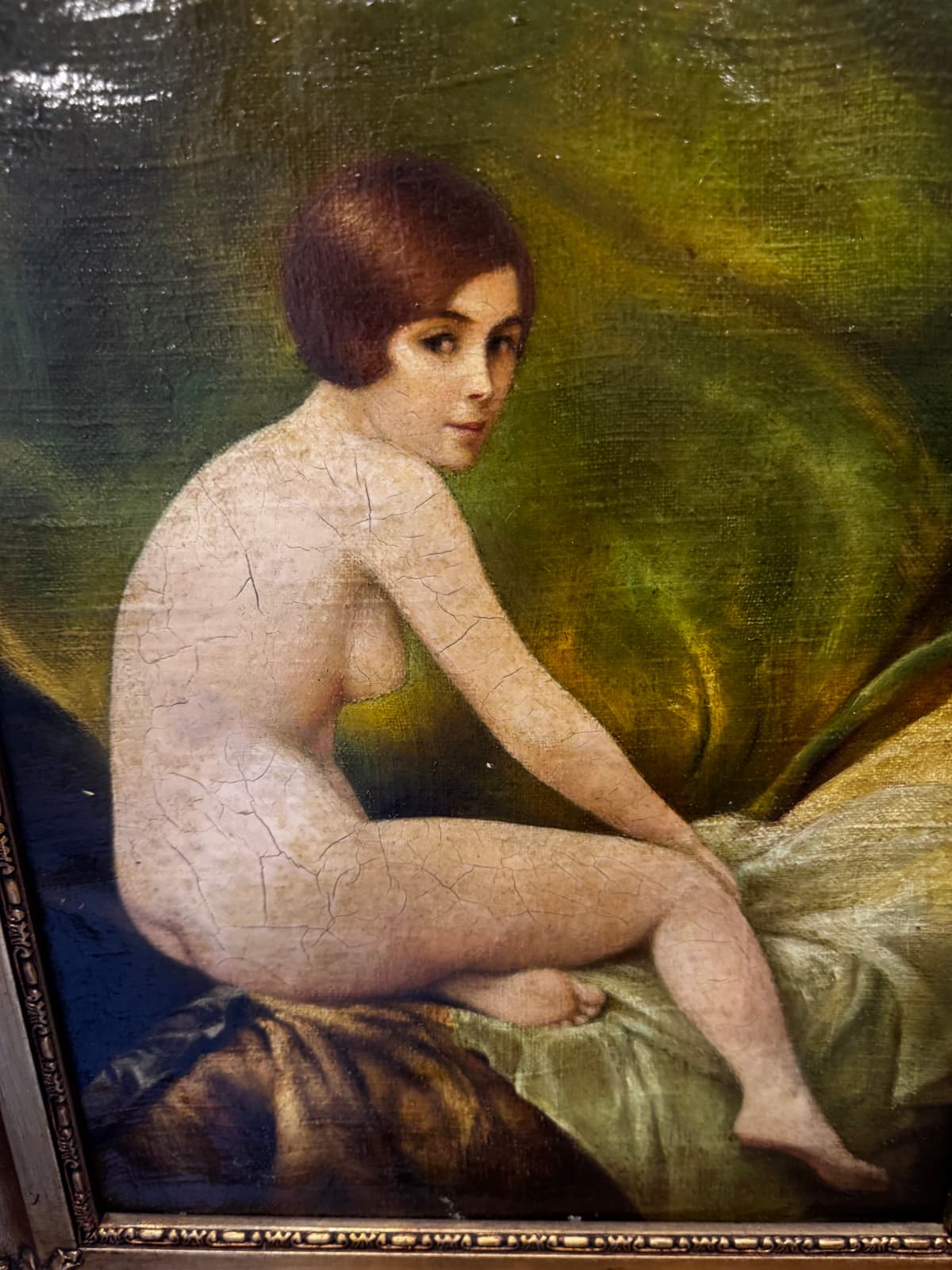
Secessionist Female Nude Artwork Data
Unknown, presumably French painter (name reading: "Blitancheid" / "Blitschneider" or similar, but cannot be definitively identified)
Theme: seated female nude, seen from behind, turning gaze, with a green drapery background
Technique: oil on canvas
Size: 30 × 39 cm
Dating: around 1900–1920 (academic-secessionist French/European school)
Condition: surface craquelure, slight darkening, support structure intact; stable even without restoration
What we see on the back:
Classic wooden frame used in the late 19th to early 20th century, secured with nails.
Canvas support, finely woven, aged patina, with craquelure on the front.
Remnants of paper frame and cardboard suggest later mounting or protective covering.
Signature or inscription is not clearly visible, but a faint brown mark can be discerned in the lower left corner. It reads “Blitancheid” - this could typically be a case of misreading an old name (e.g. Blüthencheid / Blätterscheid / Blitschneider).
Possible interpretations:
French origin: the style of the painting (delicate modeling, green drapery background, nude of a young woman) is characteristic of French academic-secessionist nude painting between 1900–1920.
– Similar works can be found in the context of Émile Vernon, Paul Chabas, Guillaume Seignac, Eugène de Blaas.Name identification: the reading "Blitancheid" is not a documented painter's name in major databases (Benezit, Artnet, Artprice). It is likely that:
either a misspelled / poorly readable letter group,
or a lesser-known regional artist (e.g., associated with the Belgian or Dutch schools).
Recommended circle based on style:
Paul Chabas (1869–1937) – famous for his delicate nudes (Matinée de Septembre).
Guillaume Seignac (1870–1924) – academic French master, similar skin tones and poses.
Émile Vernon (1872–1919) – female figures, sensuous portraits.
Édouard Bisson (1856–1939) – decorative, secessionist-inspired female figures.
Eugène de Blaas (1843–1931) – Italian-Austrian, stronger in genre scenes, but similar facial types in female figures.