Lot details
Curators

Ács Érmes Károly
curator
ermesprojekt@gmail.com

Ohnhaus Éva
curator
eva.artdeco@gmail.com
Detailed description
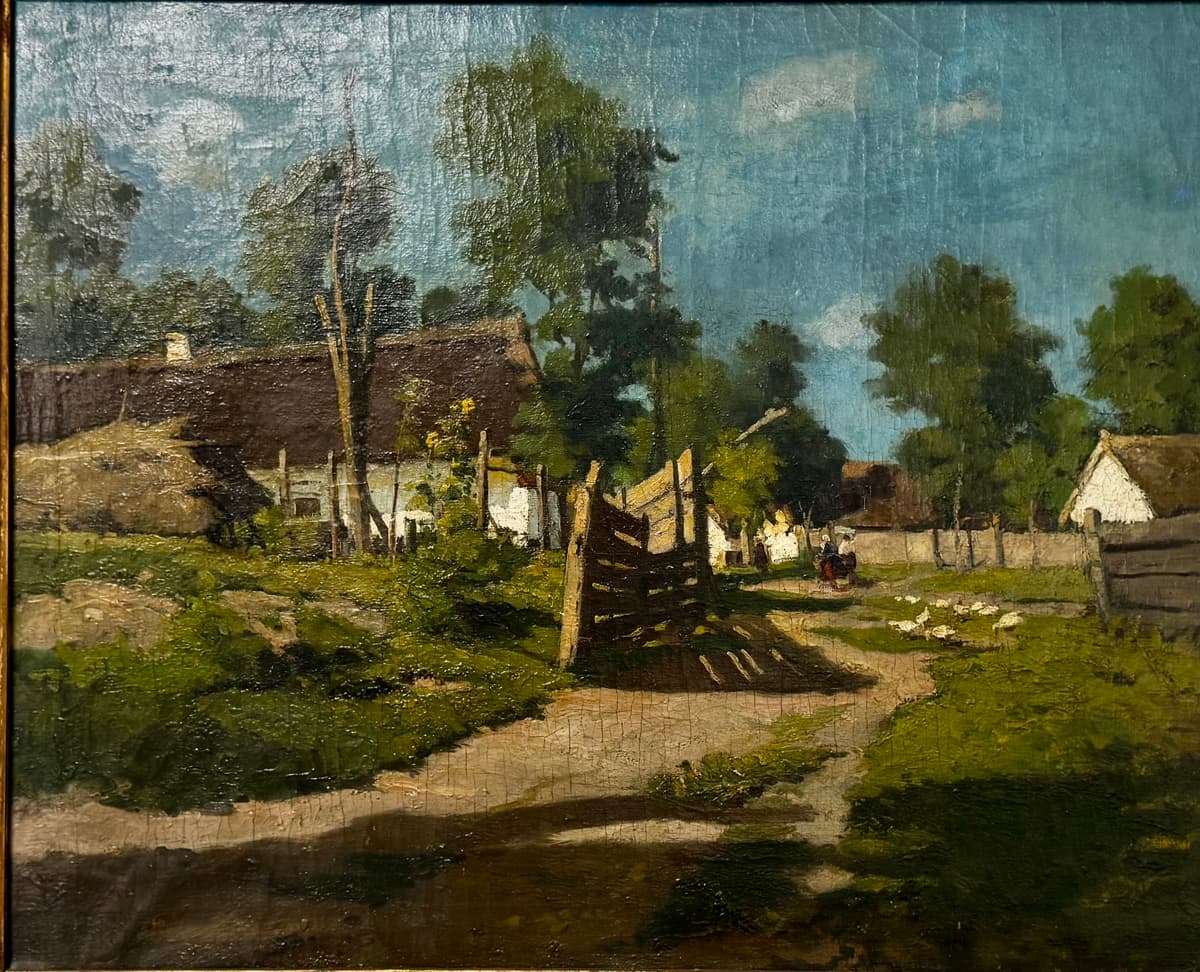
Sunlit homestead at the edge of the village
A street section at the end of the village unfolds before us: a dirt road winds in the foreground, while in the midground, an open wooden bench/gate-like fence guides the eye towards a row of whitewashed, thatched houses. On the right, a wooden fence runs, while on the left, there’s a weedy front yard and large, shade-casting trees. In the distance, two or three tiny figures – with skirts marked by red spots – bring life to the scene. The color palette is built on earthy and green tones, contrasting with a bright cheerful sky blue; sunlight strips and the shadows of the trees rhythmize the composition. The brushwork is occasionally sketchy and fresh (foliage, dirt road), while in other places, it appears denser and more pasty (house walls, gate). The modeling of light and shadows suggests the high position of the sun in the morning/afternoon. Iconographic and garment features (thatched roof, whitewashed homesteads, peasant attire) evoke the vision of Hungarian village life from the first half of the 20th century. Style: naturalistic–post Nagybánya plein air tone. Likely decade(s): 1930s–1940s.
Key Details
Open village gate as a central motif and perspective guide
Thatched, whitewashed row of houses – typical atmosphere of Kisoroszi/Danube Bend region
Contrast of light stripes on the dirt road and cool shadow bands
Loose, fragmented foliage painting; more compact treatment of buildings
Tiny figure with red accents in the distant focus
Ferenc Ujváry (1898–1971). Hungarian painter, active in the first half of the 20th century; his themes often include rural still lifes and landscapes. His painting style follows the plein air-naturalism linked to the Nagybánya tradition, with compact patch rendering and a restrained palette based on earth tones. His oeuvre is less explored in literature; his works periodically appear in domestic private collections and auctions.