Lot details
Curators

Ács Érmes Károly
curator
ermesprojekt@gmail.com

Ohnhaus Éva
curator
eva.artdeco@gmail.com
Detailed description
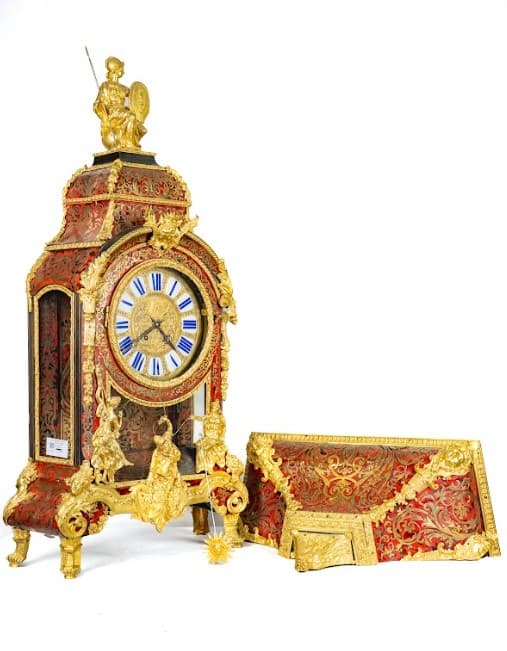
The presented item is a large French Baroque-style wall clock, richly gilded with bronze decoration and adorned with red tortoiseshell Boulle inlay. The dial, marked with blue Roman numerals, is surrounded by three-dimensional figurative appliqués and cartouches, while the upper part is crowned by an allegorical sculptural figure that completes the composition. Based on its material use, craftsmanship, and iconography, it was created in the second half of the 19th century as a historicizing reinterpretation of 17th-18th century French court clocks, a luxury item intended for a representative interior.
The Boulle technique is a classic French marquetry method developed by André-Charles Boulle (1642–1732), which decorates wooden furniture and clocks with fine metal threads, usually made of bronze and copper. The burgundy color often conceals a rich mahogany or oak base, creating an elegant contrast with the metal inlay.
Japy Frères was a French clock and watch movement manufacturing company founded in 1806 by Frédéric Japy with his sons, Pierre, Fritzcel, and Louis, establishing the Japy Frères (Japy Brothers) trademark. Japy played a pioneering role in the industrialization of clock manufacturing: he consolidated the assembly processes into a single factory in Beaucourt, significantly shortening production time and enabling mass production.
The company's enamel dials became an industrial standard in France between 1850 and 1930. Japy Frères experienced its heyday between 1850 and 1930, producing high-quality yet affordable clocks, fulfilling military orders, and receiving accolades at various international exhibitions.