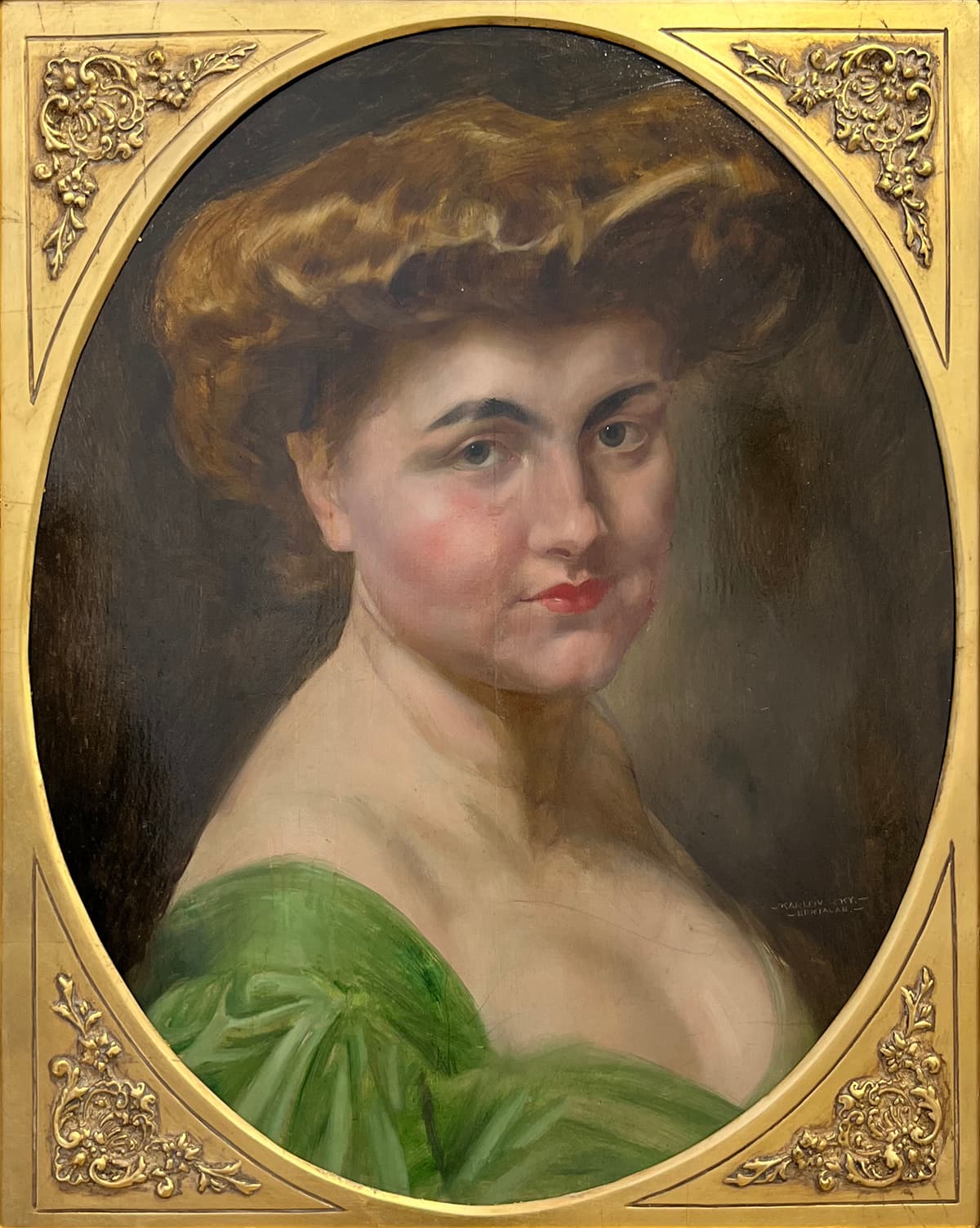
Description
No description available yet.
Curators

Ács Érmes Károly
curator
ermesprojekt@gmail.com

Ohnhaus Éva
curator
eva.artdeco@gmail.com
Detailed description
Karlovszky Bertalan: His Life and Art
Karlovszky Bertalan (1858–1927) is one of the outstanding figures of Hungarian painting, who combined elements of historicism and neo-Renaissance style in his works. Throughout his career, he experimented with various genres, from monumental frescoes to smaller, more intimate compositions, always with high-quality execution.
He studied in Paris and Vienna, where he was influenced by notable masters such as Jean-Paul Laurens and Hans Makart. He quickly gained recognition at home, won awards, and received numerous state commissions to decorate churches, public buildings, and bourgeois villas.
His style is characterized by richness of detail, subtle coloring, and compositional harmony. He often drew from mythological, religious, and historical themes, but also sensitively portrayed the everyday person. In his works, the interplay of light and shadow and the depiction of plastic forms matched the tastes of the era.
His most well-known works include the fresco of the Franciscan Church in Cluj and the decorative paintings of the Pest Hungarian Theater in Budapest. In these commissions, his monumental perspective was well manifested, while intricate ornamentation also appeared.
Karlovszky's technique combined oil and tempera painting, and he also applied gilding. His inspiration was enriched by elements of ancient art, the Italian Renaissance, and Biedermeier style, which he complemented with Hungarian motifs.
His role in Hungarian art history is significant: he taught at art academies, encouraging his students to blend historicism with modern painting. Many of his students later became well-known painters, thus his legacy continues to live on.
Overall, Karlovszky Bertalan serves as a bridge between traditional and modern trends in 19th-century to 20th-century Hungarian painting, and his works continue to captivate audiences today with their richness of detail and artistic elegance.