Description
No description available yet.
Curators

Ács Érmes Károly
curator
ermesprojekt@gmail.com

Ohnhaus Éva
curator
eva.artdeco@gmail.com
Detailed description
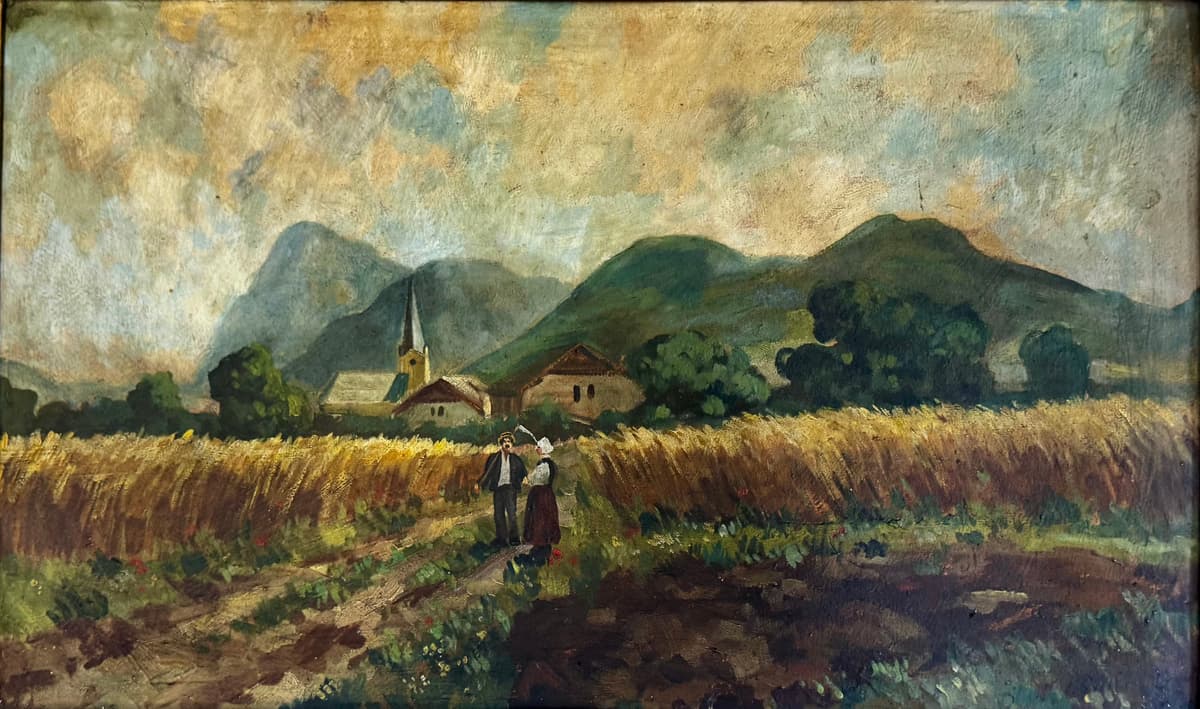
In the foreground of the painting, two peasant figures – a man and a woman – are conversing on a dirt road, flanked by fields of ripe, golden grain on both sides. In the background, the spire of a small village church and a few houses rise up, with green mountain ranges and a cloudy sky completing the composition. The color palette of the image is warm, built on brownish-yellow tones, balanced by green and blue shades. The brushwork is loose yet confident: Kunffy's favored technique is atmospheric layering, which depicts the perspective of the air through subtle color dilutions. The lights suggest an afternoon atmosphere, with the golden shimmer of the ears of grain harmonizing with the warmer cloud hues of the sky. The attire (white headscarf, black vest, long skirt, shirt) refers to the rural dress of the turn of the century.
Style direction: plein air realism – naturalistic depiction of rural life.
Probable creation: between 1910 and 1925.
Key details
Golden wheat field, atmospheric light treatment
Church tower, mountain range, cloudy sky in the background
Pair of figures in peasant attire in the field
Warm, earth-toned palette
Kunffy-style folk idyll, motifs from the Great Plain
INTRODUCING THE AUTHOR – Lajos Kunffy (1869–1962)
Biography
Lajos Kunffy was born on October 2, 1869 in Orci, Hungary. In 1874 his family moved to Kaposvár, where he attended the local grammar school. Although he initially enrolled in law school in Budapest, his true vocation soon led him to art, and he studied at the Hungarian Royal Drawing School. In 1890 he joined Simon Hollósy’s private art school in Munich, then continued his studies at the Munich Academy of Fine Arts and later at the Académie Julian in Paris.
By 1894 Kunffy was already exhibiting at the Paris Salon. A few years later, a stay in Brittany brought a new lightness and decorative rhythm to his style, influenced by modernism and the secession movement. From 1901 he lived with his wife, Ella Tiller, in Paris for over a decade, while their estate in Somogytúr served as a summer studio and source of inspiration.
After 1914 Kunffy returned permanently to Hungary, settling on his Somogytúr estate in 1934. During World War II he and his wife were deported to the ghetto in Tab, and their property was confiscated. After the war he lived quietly in Kaposvár, receiving national recognition in his later years: in 1959 he was awarded the Order of Labour, and in 1960 he received the title of Merited Artist of Hungary. He died in Kaposvár on March 12, 1962.
Artistic significance
Kunffy’s art combines academic mastery with lyrical realism. His painting was rooted in his deep attachment to the Hungarian countryside and peasant life, expressed through warm, natural tones and an atmospheric play of light. Influenced by French plein-air painting and Hungarian realism alike, his works depict a harmonious relationship between people and nature.
Artistic periods
Formative years (1890s): Academic realism shaped by Munich and Paris.
Parisian period (1901–1913): Refined plein-air technique and decorative coloration.
Somogytúr years (from 1934): Mature period with serene depictions of rural life and landscape.
Post-war years: Recognition and retrospectives highlighting his contribution to Hungarian cultural identity.