Description
No description available yet.
Detailed description
Luigi Rossini (1790–1857), a significant figure of the Italian Neoclassicism, became mainly known for his engravings. He studied at the Academy of Bologna under Antonio Basoli and Giovanni Antonio Antolini. His art focused on immortalizing the glory of ancient Rome. His career is often compared to the work of Giovanni Battista Piranesi, as he drew extensively from the latter's works.
Rossini's art aimed at the revival of the architectural heritage of ancient Rome, with detailed, precise representations and dramatic compositions. His first series of etchings was published in 1814. His series depicting the landscape of ancient Rome consisted of 101 pieces and was published in 1825.
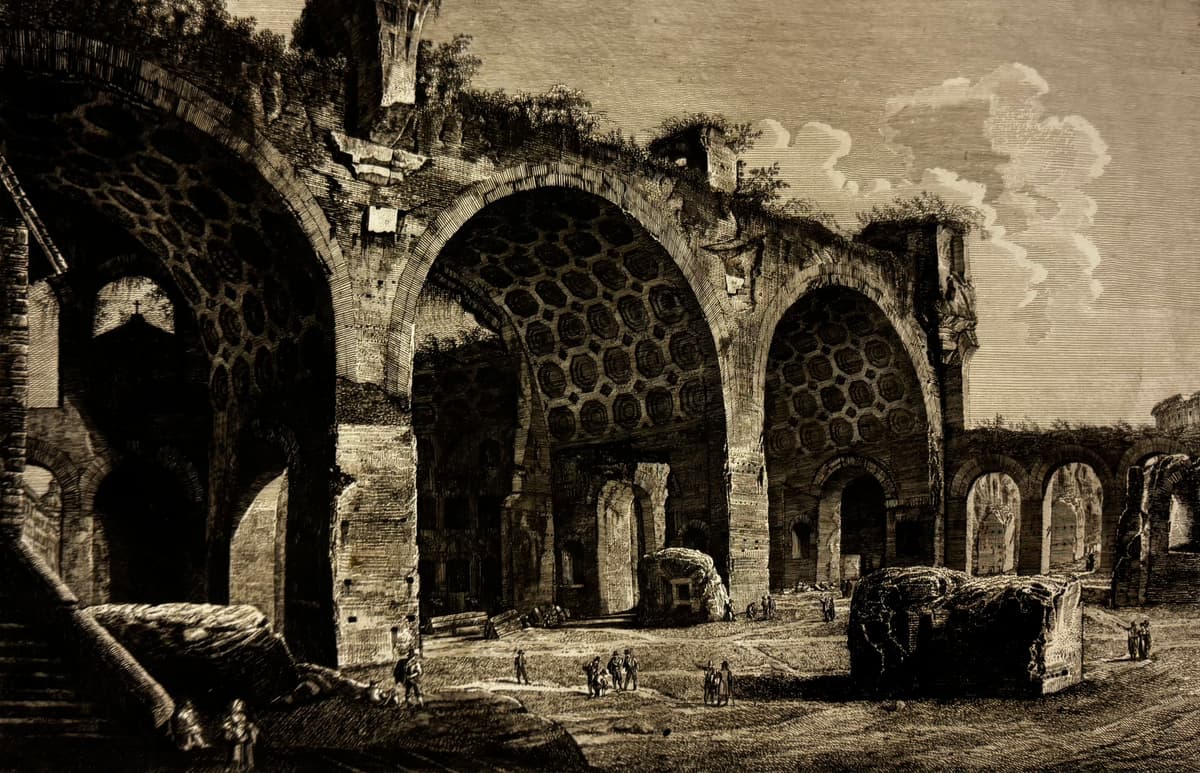
Part of this is the plate titled The Great Temple of Peace (Templum Pacis). The Great Temple of Peace was one of the imposing buildings of ancient Rome, commissioned by Emperor Vespasian in AD 71 to celebrate the triumph of the Flavian dynasty. The temple stood in the Roman forum and also housed one of the largest libraries of the ancient world. Rossini's work showcases the remains of this grand building, emphasizing its magnificent proportions and historical significance.