Lot details
Curators

Ács Érmes Károly
curator
ermesprojekt@gmail.com

Ohnhaus Éva
curator
eva.artdeco@gmail.com
Detailed description
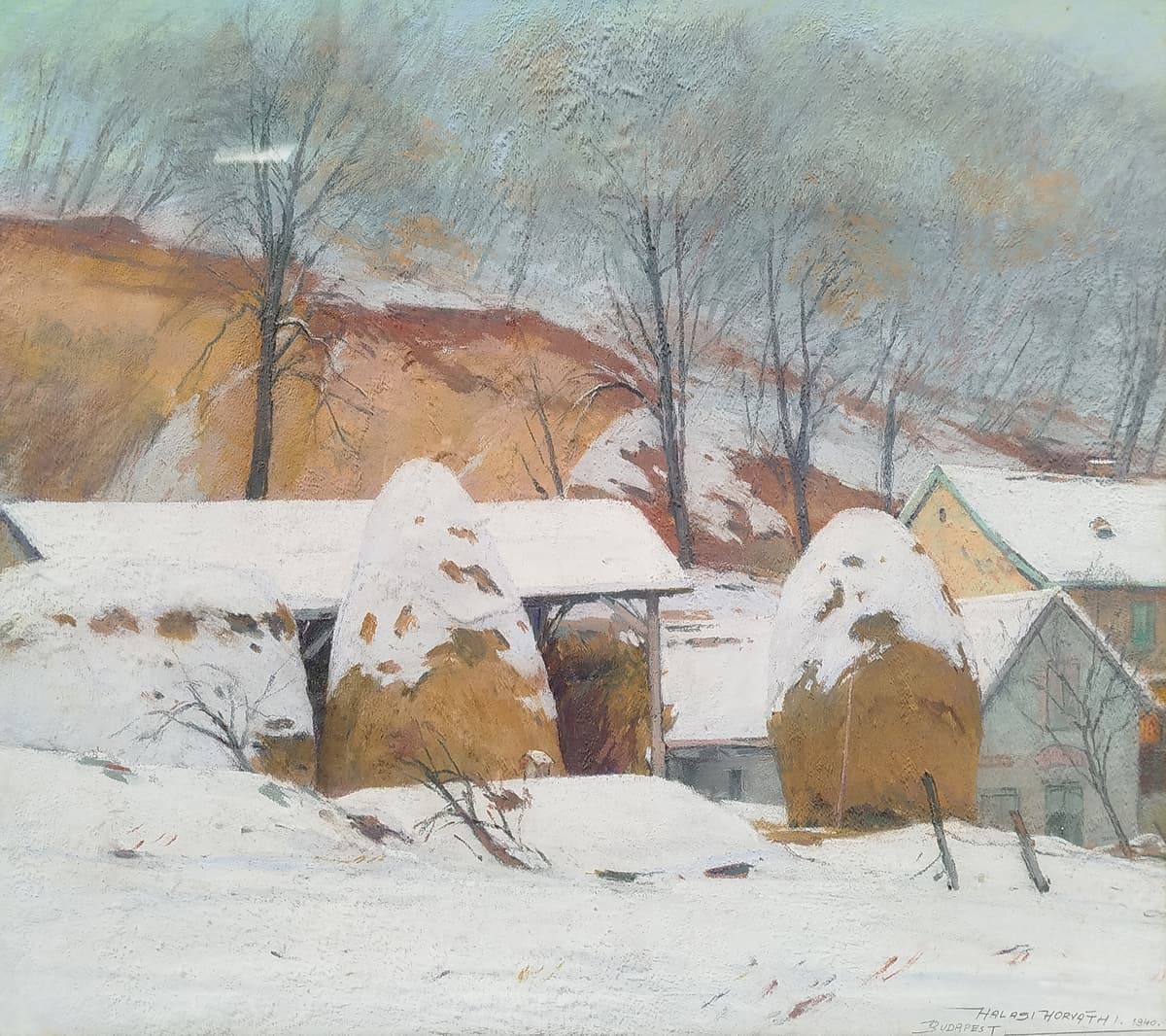
The painting depicts a snowy hillside village scene, with thatched roofs, snowy haystacks, and buildings glowing in bright winter light.
The colors are muted, yet rich in harmony: tones of rusty ochre and whitish grey reflect the lights of winter.
The composition allows for a vast sense of aerial perspective, where an orange-brown hillside meets a bluish sky in the background.
The painter works with fine texture, the materiality of the snow and straw is applied in a pastose manner, while the distant hills and sky are constructed with soft brushwork. This airy treatment of color is akin to the perspective of the great painters of the plains – Gyula Rudnay, Béla Iványi-Grünwald, and István Szőnyi – but reflects Halasi Horváth's own gently realistic vision.
Art Historical Background
István Halasi Horváth was one of the finest landscape painters of Hungarian painting between the two world wars. He graduated as a student of Gyula Rudnay at the Academy of Fine Arts, later creating in Budapest and Szentendre.
He most often found his themes in rural and plain environments – his paintings strive not for monumentality, but to capture the silence, colors, and light conditions of nature.
István Halasi Horváth – Master of Innovation
István Halasi Horváth (1885–1952) is a prominent figure in Hungarian painting, spanning from the turn of the century's Art Nouveau to the new realism between the two world wars. His art is characterized by meticulous handling of form and a personal tone. During his life, he combined classical academic training with the experimental spirit of modern movements.
He studied at the Academy of Fine Arts in Budapest, where he was influenced by masters including Károly Lotz and Alajos Stróbl. Even as a student, he stood out with his unique use of color, and soon could work on international scholarships in Vienna and Paris. These years shaped his later rich palette and finely toned compositions.
His style is characterized by a combination of naturalistic detail and lyrical tone. His works often depict rural landscapes, portraits, and still lifes. He is particularly known for the canvas titled “Ploughing”, which reflects the vibrant colors of the countryside bathed in sunlight. With his painting titled “Portrait of Piroska”, he captured the delicate layers of the human soul.
Between 1925 and 1935, he participated in several solo exhibitions in Budapest, Pest, and provincial galleries. Critics greatly appreciated his artistic maturity and his ability to maintain the harmony of composition even in details. In 1930, he received the Munkácsy Mihály Prize, which further solidified the rank of his career.
The works of István Halasi Horváth not only encompass contemporary styles but also transcend competing movements, thus enriching the diversity of contemporary domestic art. From the post-war years, he also taught, inspiring younger generations towards professional excellence and the pursuit of a personal vision.
Today, his works can be found in the Hungarian National Gallery and several provincial museums. István Halasi Horváth's legacy lies in the fact that by continuously maintaining the dialogue between tradition and innovation, he created enduring values in 20th-century Hungarian painting.