Description
No description available yet.
Curators

Ács Érmes Károly
curator
ermesprojekt@gmail.com

Ohnhaus Éva
curator
eva.artdeco@gmail.com
Detailed description
Selected Group Exhibitions2021Reinterpreting the Classical: From the Drawing to the Romantic View in Historical Graphics ,m.a.x.museo ,Chiasso, Switzerland2016Real Estate of the Ancients Karshan Center of Graphic Art ,MOAS, Museum of Arts and Sciences ,Daytona Beach, Florida, USA
Luigi Rossini was an Italian 19th Century artist who was born in 1790. Numerous key galleries and museums such as Minerva Auctions have featured Luigi Rossini's work in the past.Luigi Rossini's work has been offered at auction multiple times, with realized prices ranging from 12 USD to 33,828 USD, depending on the size and medium of the artwork. Since 2000 the record price for this artist at auction is 33,828 USD for 32 works: I SETTE COLLI DI ROMA ANTICA E MODERNA, sold at Pandolfini in 2014. In the past 12 months, their prints & graphic art have averaged 599 USD.
Luigi Rossini in the news
In MutualArt’s artist press archive, Luigi Rossini is featured in The Visible Invisible Man, a piece from Fine Art Connoisseur in March 2019. The artist died in 1857.
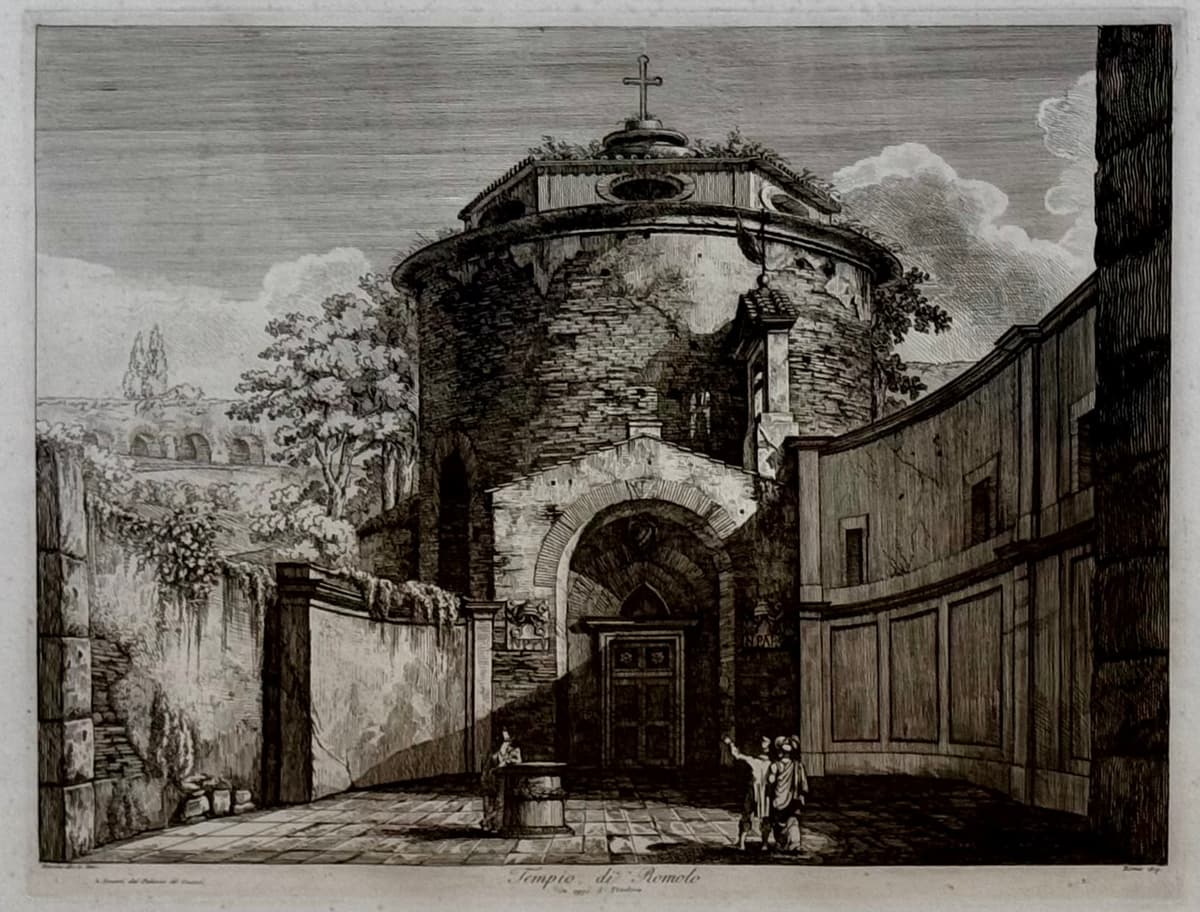
Luigi Rossini (1790–1857) placed a special focus on the religious structures of the Roman Forum in his work, including the Temple of Romulus. The circular building was constructed in the 4th century AD by Emperor Maxentius and is believed to have been dedicated in memory of his son, Valerius Romulus, who died at a young age.
The temple, characteristic of classical Roman architecture, featured finely crafted decorations and Corinthian columns. Its original bronze door, which has survived to this day, remains the most distinctive element of the structure. With the spread of Christianity, the building was later transformed and is now part of the Church of Santi Cosma e Damiano.
Rossini's etching meticulously depicts the structure of the Temple of Romulus, including its dome, columns, and other elements of the Roman Forum visible in the background. The representation emphasizes the temple’s location and significance in the religious life of ancient and medieval Rome.
This artwork not only captures the architectural beauty of the temple but also highlights its historical importance. Rossini subtly conveys the building's connection to the cultural shifts of Roman society, illustrating the transition from pagan religion to Christianity. The Temple of Romulus stands as a symbol of the durability and cultural richness of Roman architecture.